
Direct answer
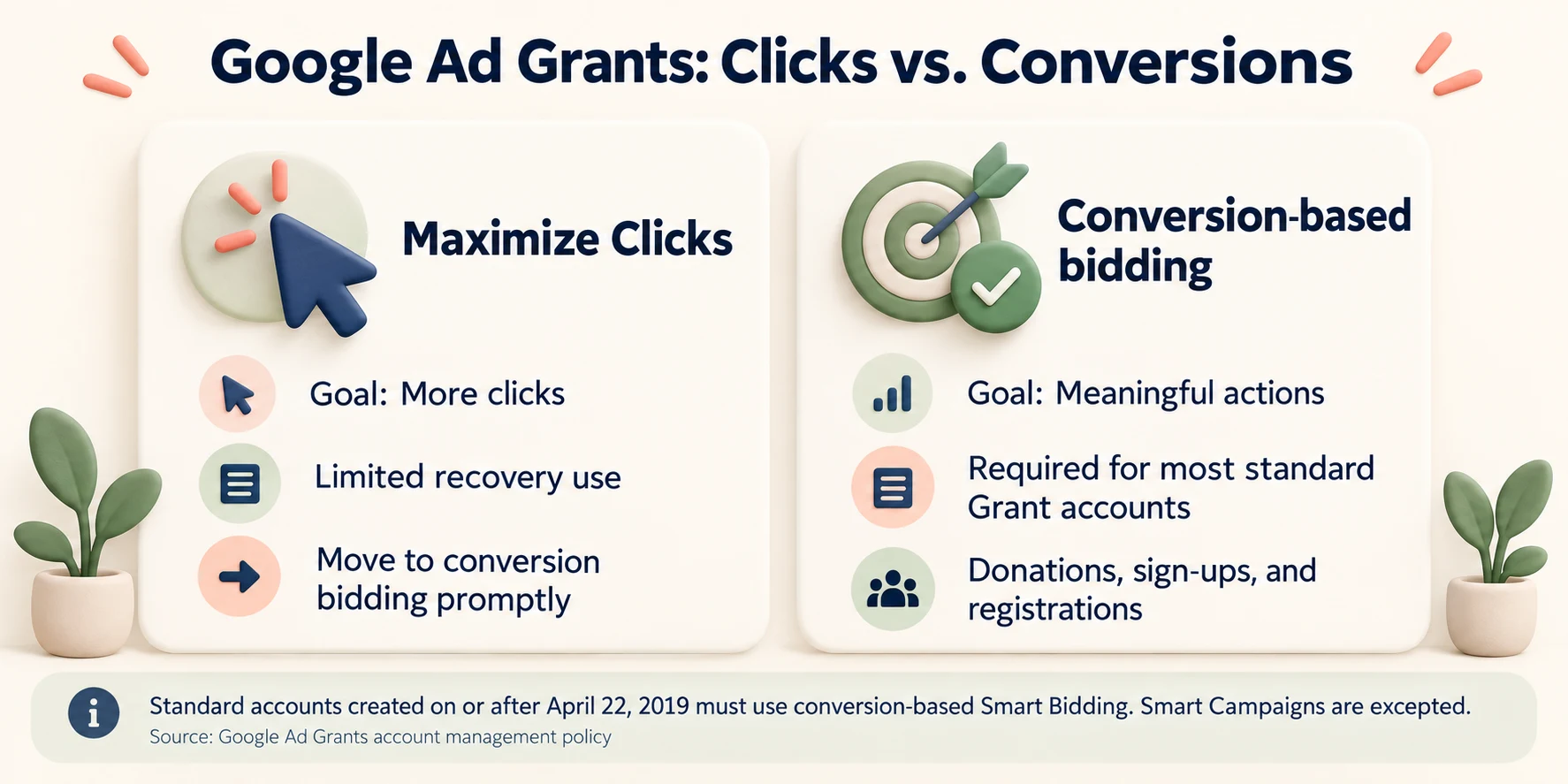
Usually, no. For standard Google Ad Grant accounts created on or after April 22, 2019, Google requires conversion-based Smart Bidding for campaigns. The approved strategies are Maximize Conversions, Maximize Conversion Value, Target CPA, and Target ROAS.
Google does mention Maximize Clicks as a temporary way to gather initial traffic and data if an account has been deactivated for a bidding-policy problem. That is a recovery step, not a general permission to run Maximize Clicks indefinitely.
Key takeaways
- Maximize Clicks is designed to get as many clicks as possible within a budget. It does not optimize directly for donations, volunteer registrations, or other meaningful nonprofit actions. For the broader donation-focused strategy, see my guide to using the Google Ad Grant for nonprofit donations.
- Most standard Grant accounts must use one of Google's conversion-based bidding strategies.
- If Google tells you to begin with Maximize Clicks after a bidding deactivation, set up accurate conversion tracking immediately and move to conversion-based bidding as soon as the account has enough useful data.
- Google says 15 to 30 conversions in the last 30 days can be a good starting point for the algorithm. That is a starting point, not a universal rule for every nonprofit.
- The 5% account-level CTR requirement is separate from the bidding requirement. More clicks do not automatically make a Grant account compliant.
Can you use Maximize Clicks in a Google Ad Grant account?
The answer depends on why you are using it and which type of account you have.
| Situation | What the policy means |
|---|---|
| Standard Grant account created on or after April 22, 2019 | Use conversion-based Smart Bidding for campaigns. Maximize Clicks is not the normal long-term strategy. |
| Account deactivated for a bidding-policy problem | Google says you can begin with Maximize Clicks to gather initial traffic and data, then switch to an approved conversion-based strategy after implementing tracking. |
| Smart Campaigns account | Smart Campaigns follow a separate automated setup. Do not assume that a Maximize Clicks setting from a standard Search campaign applies to Smart Campaigns. |
| Older Grant account | The current policy wording specifies accounts created on or after April 22, 2019. Check the account's in-product notices and current policy before assuming an older account is exempt. |
Google also says campaigns that do not comply with the bidding policy may be subject to automatic bid-strategy changes. Check the actual setting in Google Ads instead of relying on an old campaign setup or a third-party screenshot.
What does Maximize Clicks actually do?
Google describes Maximize Clicks as an automated bid strategy that adjusts maximum cost-per-click bids to help get as many clicks as possible within a budget. You can set a maximum CPC limit, although setting the limit too low can restrict the strategy's ability to find traffic.
The strategy is built around clicks. It does not know whether a click led to a donation, a volunteer registration, a petition signature, a qualified inquiry, or an accidental visit unless that information is measured separately.
That distinction matters for an Ad Grant. The grant provides advertising credit, but the nonprofit still has limited time, limited staff capacity, and a mission that depends on useful actions. A campaign that produces inexpensive clicks without meaningful engagement can look busy while doing little for the organization.
Why does Google require conversion-based bidding for most Grant accounts?
Google's account management policy says accounts created on or after April 22, 2019 must use conversion-based Smart Bidding for all campaigns, unless they are using Smart Campaigns. The listed strategies are:
- Maximize Conversions
- Maximize Conversion Value
- Target CPA
- Target ROAS
The purpose is to give Google's bidding system a signal tied to an action the nonprofit values. Depending on the organization, that action could be a donation, ticket purchase, membership registration, volunteer sign-up, petition signature, information request, or phone call.
This makes accurate conversion tracking part of the bidding setup, not a reporting task to postpone. Google's conversion-tracking guide for Ad Grants says an active account must record at least one conversion per month and that the conversion should be meaningful. Time on site and homepage visits should not be treated as the account's main meaningful conversion simply because they are easy to count.
When does Google say Maximize Clicks can be used?
Google's exception is specific. If an account is deactivated for a bidding-policy problem, Google says you can begin with Maximize Clicks to gather initial traffic and data. The same guidance says to implement conversion tracking immediately and switch to Maximize Conversions or Maximize Conversion Value as soon as there is enough data.
A practical recovery sequence is:
- Read the account's in-product notice and identify the bidding issue.
- Set up one or more meaningful conversion actions, such as a donation confirmation, volunteer registration, membership form, or qualified inquiry.
- Confirm that the conversion fires correctly and reaches Google Ads.
- Use Maximize Clicks only for the temporary data-collection period Google describes.
- Move to the appropriate conversion-based strategy and request reinstatement after correcting the policy issue.
The timing depends on the account. Google says that 15 to 30 conversions in the last 30 days is typically a useful starting point for the algorithm. That does not mean every nonprofit should wait for exactly 15 conversions, or that 15 low-quality events make a campaign ready. The quality and consistency of the conversion signal matter.
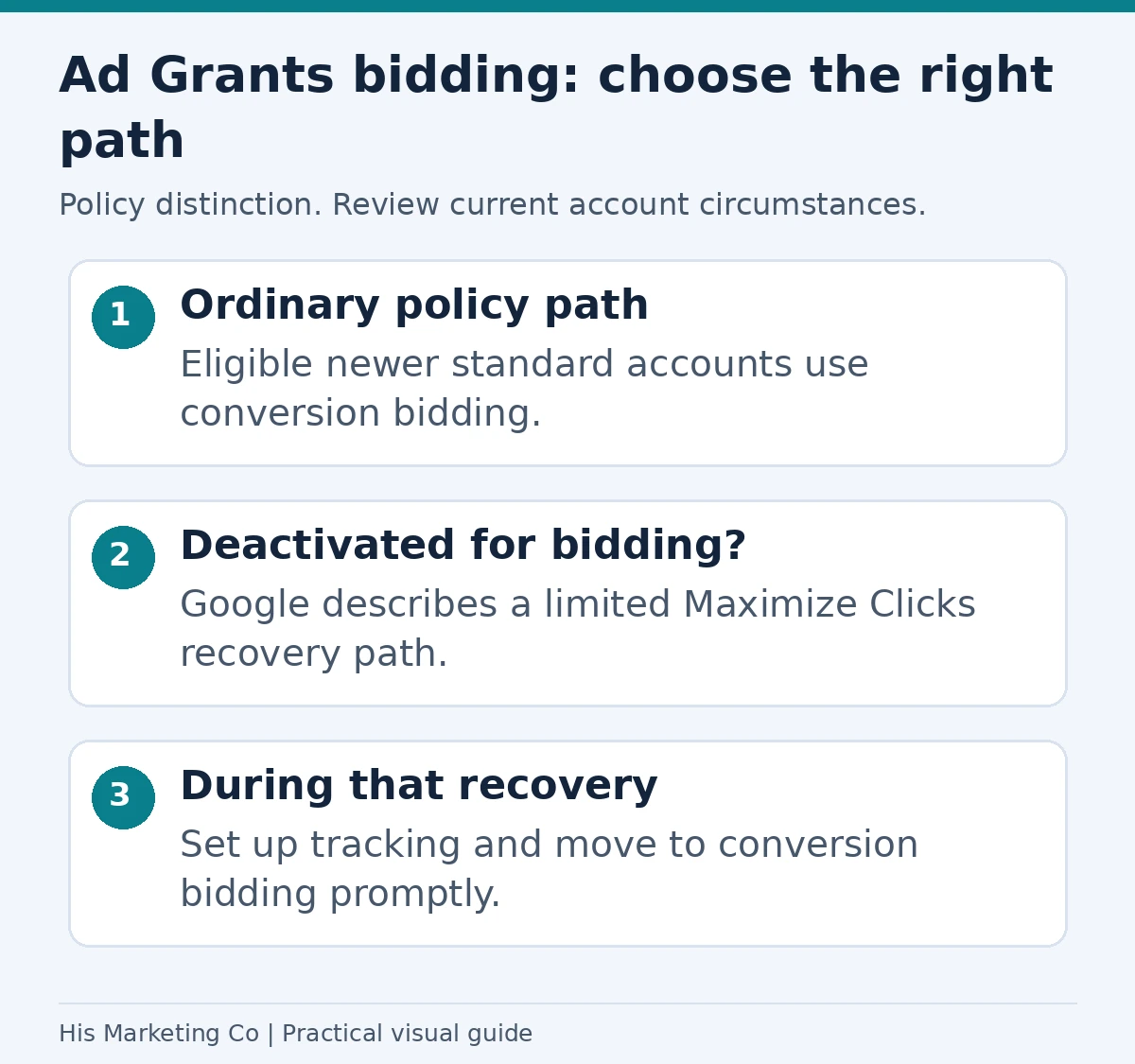
Google requires conversion-based Smart Bidding for standard accounts created on or after April 22, 2019, with the Smart Campaigns exception. Its bidding-deactivation recovery section describes limited Maximize Clicks use while tracking is implemented and conversion bidding is restored. This is not blanket permission. Account management policy.
Which bidding strategy should a nonprofit use instead?
Maximize Conversions is designed to seek as many conversions as possible within the campaign's budget. It is the natural starting point when the nonprofit counts meaningful actions but does not assign reliable values to them. Google's documentation says conversion tracking must be set up for this strategy.
Maximize Conversion Value is useful when actions have different values, such as donations of different amounts or a mix of donations, ticket sales, and registrations with assigned values. The values need to reflect the nonprofit's goals rather than being arbitrary numbers added only to satisfy the bidding setting.
Target CPA can make sense when there is a stable cost-per-action goal and enough consistent data to evaluate that target. A target that is too aggressive can limit delivery, especially in a small account.
Target ROAS fits situations where conversion values are meaningful and the organization has enough history for a return target to guide bidding. It is not automatically the best choice just because donations have dollar values.
I would choose the strategy based on the action being measured, the volume and quality of the data, and the organization's actual objective. The available strategies are policy requirements. They are not a substitute for deciding what a valuable nonprofit action means.
Can Maximize Clicks help you reach the 5% CTR requirement?
It can produce clicks, but I would not use it as a plan for reaching the 5% requirement.
Google requires most Ad Grant accounts to maintain at least 5% CTR each month at the account level. The requirement is about the combined relationship between clicks and impressions. Google defines CTR as clicks divided by impressions.
A click-focused strategy may increase click volume, but it can also buy traffic that is weakly related to the mission. If those impressions do not earn clicks, or the clicks do not lead to meaningful actions, the account still has a performance problem.
In the accounts I manage, I start with a focused campaign built around strong mission-relevant search intent and clear ad-to-landing-page alignment. That gives the account a better foundation for CTR and conversion data. I then use conversion-based bidding and monitor other campaigns as they expand. I do not treat Maximize Clicks as a way to inflate the account average or avoid improving relevance.
For more on protecting CTR while evaluating broader matching, see AI Max in Google Ad Grants.
What should you check before changing the bid strategy?
Before switching to Maximize Clicks or another strategy, check:
- Account status: Is Google identifying a bidding, tracking, CTR, or account-structure problem?
- Campaign type: Is this a standard Search campaign or a Smart Campaign?
- Conversion goal: Does the primary conversion represent a real nonprofit action?
- Tracking quality: Does the form, donation, registration, or call actually appear in Google Ads?
- Conversion volume: Is there enough recent, reliable data for the strategy you want to use?
- CTR: Is the account safely above the monthly requirement, with enough margin for normal variation?
- Search intent: Are the searches closely connected to the nonprofit's mission and the landing page?
- Follow-up: Is someone on the nonprofit team able to respond to the actions the campaign generates?
If the account is new, start by applying for Google Ad Grants and setting up meaningful measurement before expanding campaigns. If the account has been rejected or deactivated, see what actually fixes a rejected Google Ad Grant account.
What should you do if Google changed your bid strategy?
First, document the current campaign setting and read the account notification. Then verify that conversion tracking is active and that at least one meaningful action is recording each month.
If Google changed a campaign away from Maximize Clicks, that may be the platform enforcing the current bidding policy. Do not switch it back automatically. Confirm the account's creation date, campaign type, conversion setup, and current policy notice.
If the account is being rebuilt, I would focus on one tightly themed campaign first. After the tracking works and the campaign has useful data, expand into additional campaigns that support the nonprofit's actual goals. This sequence makes it easier to see which changes affect CTR, conversion volume, and lead quality.
Methodology
I checked Google's current Ad Grants account management policy, CTR requirements, conversion-tracking guide, policy-compliance guide, and Google Ads documentation for Maximize Clicks and Maximize Conversions. The article separates Google's stated policy from my account-management recommendations. No His Marketing Co client results or performance statistics are presented. Policies and interface options can change, so account owners should also review current in-product notices.
If you want help with Google Ad Grant management, I can review the bidding strategy, conversion setup, CTR trend, and campaign structure together.