
Direct answer
Google Ads can increase nonprofit donations when they match high-intent searches to a focused donation page and reliable conversion tracking. Eligible organizations can also use the Google Ad Grant for up to $10,000 per month in free Google Search advertising. The strongest plan combines grant-funded discovery with paid campaigns for urgent, competitive, or high-value donation searches.
Executive summary
- Google reports that eligible nonprofits can receive up to $10,000 per month in Google Search ad credit. That is a maximum annualized value of $120,000 if fully used.
- Search ads reach people who already express a need, cause interest, or donation intent. This often makes Google a strong channel for direct-response fundraising.
- Google’s published examples include more than 5,000 donations for DonorsChoose, a $212 average donation for Days for Girls, and more than $48,000 in online donations for Samaritans.
- The grant does not replace strategy. Nonprofits still need eligible campaigns, conversion tracking, strong landing pages, and ongoing optimization.
Important: Google’s case-study results are Google-reported examples. They are useful benchmarks, not guarantees for every nonprofit.
Why can Google Ads be effective for nonprofit donations?
Google Ads can work well for donations because the person searches before seeing the message. A query such as “donate to help animals” signals more intent than a passive social media impression.
That difference matters. Google Search can capture demand from people looking for a cause, a local organization, a specific intervention, or a way to give today. It can also connect urgent campaigns with donors who need a clear next step.
Google’s official Ad Grants page says the program helps nonprofits raise awareness, attract donors, and recruit volunteers. Its published examples include DonorsChoose driving more than 5,000 donations, Days for Girls reporting a $212 average donation, and Samaritans reporting more than $48,000 in online donations.
These examples do not prove that Google will outperform every other channel. They show the type of outcome that search advertising can support when the offer, intent, and donation experience align.
The most effective approach is usually a full path:
- A person searches for a relevant problem or cause.
- The ad makes a specific promise.
- The landing page explains the impact of giving.
- The donation form makes the next step easy.
- Conversion data shows which searches produce meaningful results.

The strongest nonprofit search campaigns connect the keyword, ad, donation page, form, analytics, and follow-up process.
What is the difference between Google Ads and the Google Ad Grant?
Google Ads is the advertising platform. The Google Ad Grant is a nonprofit benefit that provides eligible organizations with free Google Search ad credit under program policies.
| Option | Cost to the nonprofit | Best use | Main limitation |
|---|---|---|---|
| Google Ad Grant | Up to $10,000 per month in qualifying Google Search ad credit | Educational searches, cause discovery, volunteers, events, and donation-intent campaigns | Eligibility, policy, account-quality, and campaign restrictions apply |
| Paid Google Ads | The nonprofit pays the media budget | Urgent fundraising, competitive donation terms, remarketing alternatives, and campaigns requiring more control | Requires a real cash budget and careful return-on-ad-spend management |
| Facebook and Instagram ads | The nonprofit pays the media budget | Awareness, storytelling, audience development, retargeting, and visual campaigns | People may not be actively searching for a solution when they see the ad |
Google reports that the grant can provide up to $10,000 per month. That figure is an advertising-credit ceiling, not a donation guarantee. A nonprofit should evaluate performance using completed donations, qualified leads, recurring donors, and cost per meaningful conversion.
The best setup is often complementary. Use the grant to build qualified traffic and discover search demand. Use paid Google Ads when a campaign needs higher control, broader bidding options, or a more competitive keyword set. Use social advertising when the campaign depends on emotional storytelling and audience creation.
Is the Google Ad Grant available to every nonprofit?
No. Eligibility depends on the organization’s legal status, country, account verification, website quality, and compliance with Google’s current policies. If website requirements or domain approval are blocking your application, see our guide to fixing Google Ad Grants rejections.
For many U.S. organizations, eligibility commonly involves 501(c)(3) status and nonprofit verification through Google for Nonprofits or its validation partner. Candid explains that applicants should confirm eligibility, complete verification, and follow the program’s advertising requirements. Hospitals, schools, government entities, and some related organizations may have different rules or exclusions.
Before building campaigns, complete this checklist:
- Confirm your organization’s legal status.
- Check the current Google for Nonprofits eligibility rules for your country.
- Complete any required TechSoup or validation-partner verification.
- Enroll in Google for Nonprofits.
- Apply for or activate the Ad Grant.
- Review the current Ad Grants account, keyword, conversion, and website policies.
- Confirm that your donation page works on mobile devices.
For the enrollment and activation steps, follow our guide to applying for a nonprofit Google Ad Grant.
Eligibility is not a one-time marketing task. Google can require ongoing compliance. Policies can change, so use the current Google Ad Grants policy documentation as the final authority.
Which donation keywords should a nonprofit target?
Start with the donor’s problem, cause, location, and desired action. Do not begin with a long list of generic words such as “charity” or “donate.” Those terms may be broad, expensive, or difficult to connect to a measurable outcome.
Think in terms of search intent instead of trying to insert a list of SEO phrases into the page. The words donors use should determine the ad, landing page, and conversion you build around them.
| Search intent | Example search | Best destination |
|---|---|---|
| Direct donation | “donate to [cause]” or “help [specific population]” | A focused donation page |
| Local giving | “give to [cause] near me” or “[cause] nonprofit near me” | A local program or donation page |
| Program research | “[cause] community program” or “how does [program] work” | A program or impact page |
| Volunteer action | “volunteer for [cause]” | A volunteer application page |
| Event action | “[cause] awareness event” | An event registration page |
| Organization research | “[organization name]” | A useful branded landing page |
For example, “donate school supplies” should lead to a page about providing school supplies. “Volunteer at a food bank” should lead to a volunteer page. “What is food insecurity?” may be better suited to an educational page than a donation request.
The important question is not whether a phrase appears on the page. It is whether the searcher finds the answer and next step they expected.
Avoid sending every search to the homepage. Search relevance improves when the keyword, ad, page headline, and call to action describe the same action.
How should a nonprofit structure its campaigns?
A nonprofit should organize campaigns around goals, audiences, and landing pages. A simple starting structure can use four campaigns:
- Donation campaign: Direct donation and recurring-giving searches.
- Program campaign: Searches related to the organization’s service or intervention.
- Volunteer or event campaign: Volunteer applications, event registrations, and community participation.
- Brand campaign: Searches for the organization’s name and branded programs.
Keep each ad group tightly related to one intent. Use several responsive search ads that explain the problem, the solution, and the next step. Include the organization’s name in relevant ads so people understand who will receive the donation.
Build negative keywords before launch. Examples may include jobs, salaries, free downloads, school assignments, unrelated products, and other searches that cannot produce a donation or qualified action. Before enabling broader matching or automated campaign settings, review our guide to AI Max in Google Ad Grants.
Google’s current policy is the final reference for grant compliance. Its policy documentation says single-word keywords are generally not allowed under the mission-based keyword policy, with limited exceptions. Review the live policy before applying a broad keyword list.
Recommended campaign fields
| Field | Example |
|---|---|
| Campaign goal | Online donations |
| Search theme | Donate school supplies |
| Geographic target | Service area, state, or country |
| Landing page | /donate-school-supplies/ |
| Primary conversion | Completed donation |
| Secondary conversion | Donation form started |
| Supporting conversion | Email signup or volunteer application |
The account should make it easy to answer one question: which searches produce meaningful donor actions?
What should a nonprofit donation landing page include?
A donation landing page should reduce uncertainty and make impact visible. It should explain what the organization does, who benefits, why the work matters now, and what the donation enables.
Include these elements:
- A specific headline that matches the search intent.
- A short explanation of the problem.
- A clear impact statement for common gift amounts.
- Trust signals, such as financial information, testimonials, partners, or program evidence.
- A visible donation button above the fold.
- Suggested one-time and recurring amounts.
- A short, mobile-friendly donation form.
- Secure payment language.
- An explanation of what happens after the donation.
- A confirmation page that records the donation conversion.
Avoid vague headlines such as “Make a Difference.” Use a concrete promise instead, such as “Help provide weekend meals for local students.” The exact wording must reflect the organization’s real program and evidence.
Recurring giving deserves special attention. A donor who gives monthly can have a higher long-term value than a one-time donor, but the page must explain the recurring commitment clearly. Never hide the frequency or make cancellation information difficult to find.
For ethical fundraising, use respectful language. The Association of Fundraising Professionals warns against reducing communities to transactions and describes a common pattern as, “Here is the problem. Here is the cost. Here is how you can help.” Use that structure for clarity, while grounding it in dignity, agency, equity, trust, and belonging.

Donation tracking helps separate traffic from real fundraising outcomes, including completed gifts and recurring donors.
What conversion tracking should a nonprofit set up?
Conversion tracking determines whether the campaign creates donations or only traffic. Set it up before spending significant budget.
Track at least these events:
- Completed one-time donation.
- Completed recurring donation.
- Donation form started.
- Donation form abandoned, where technically possible.
- Volunteer application completed.
- Event registration completed.
- Email or SMS signup.
- Contact form completed.
Use Google Tag Manager, Google Analytics 4, the donation platform’s native integration, or Google Ads conversion tracking. Where possible, pass the donation value and transaction identifier. Deduplicate events so one donation does not count twice.
Set the completed donation as the primary conversion. Treat form starts, page views, and signups as secondary conversions unless they directly support the organization’s goal. A high number of clicks can look positive while hiding a broken form or an unclear donation request.
Create a simple reporting view with these fields:
| Metric | Why it matters |
|---|---|
| Impressions | Shows available search visibility |
| Clicks | Shows traffic generation |
| Click-through rate | Shows ad relevance |
| Donation conversion rate | Shows landing-page and offer effectiveness |
| Completed donations | Shows the primary outcome |
| Donation value | Shows financial result |
| Cost per donation | Shows paid-media efficiency |
| Recurring donor rate | Shows longer-term value |
Google Ads can optimize only toward the signals it receives. If it sees page views instead of completed donations, it may find more people who view pages rather than more people who give. When choosing a bidding strategy, see whether you can use Maximize Clicks in Google Ad Grants and how it differs from conversion-based bidding.
When should a nonprofit use paid Google Ads alongside the grant?
Use paid Google Ads when the grant cannot provide enough control, volume, or eligibility for the campaign. The grant is valuable, but the free credit does not remove every constraint.
Paid campaigns may make sense when:
- The organization needs to promote an urgent disaster or emergency appeal.
- The keyword set is highly competitive or commercially valuable.
- The campaign requires bidding or targeting options unavailable under the grant.
- The nonprofit wants to protect branded search visibility.
- A time-limited event needs predictable traffic.
- The organization has reliable donation tracking and a tested landing page.
Do not move into paid advertising simply because the account has clicks. Move when the nonprofit can connect spend to a measurable outcome and has a reasonable plan for donor follow-up.
A practical budget decision
Start with the grant for eligible, non-branded search themes. Add a small paid test for one high-intent campaign. Compare completed donations, donation value, recurring gifts, and donor quality over a defined period.
For example, a $1,000 paid test that produces 20 completed donations has a simple average acquisition cost of $50 per donation. That figure is only useful when the donations are real, the tracking is deduplicated, and the organization considers average gift value and donor lifetime value.
The $50 figure is an example calculation, not a benchmark. Each nonprofit should set its own acceptable acquisition cost based on its mission, average gift, retention, and fundraising economics.
Is Google Ads better than Facebook ads for nonprofit fundraising?
Google Ads is often better for capturing existing donation intent. Facebook and Instagram ads are often better for creating awareness, telling visual stories, and reaching audiences before they search.
The answer depends on the campaign stage.
| Fundraising need | Likely stronger starting channel | Reason |
|---|---|---|
| Someone is actively looking for a way to donate | Google Search | The query can express immediate intent |
| A new cause needs awareness | Facebook or Instagram | Visual storytelling can introduce the issue |
| A donor visited the donation page but did not give | Retargeting, where allowed and consented | The audience already knows the organization |
| A local event needs registrations | Google Search plus social promotion | Search captures intent, social expands reach |
| A complex issue needs education | Both channels | Social creates attention, search captures follow-up questions |
Meta’s nonprofit advertising guidance highlights tools such as the Meta Pixel and Conversions API for tracking actions, retargeting visitors, and building audiences. That makes Meta useful for audience development. Google Search complements it by capturing people who express an active need.
Do not claim that one channel universally converts better. Compare the channels using the same definitions, attribution window, donation value, and reporting period. A fair test measures completed donations, recurring gifts, qualified donor actions, and follow-up performance.

Google Search often captures existing intent, while Facebook and Instagram are stronger for awareness and visual storytelling.
What do Google’s nonprofit case studies show?
Google publishes several nonprofit examples that demonstrate possible outcomes from search advertising:
- DonorsChoose reports more than 5,000 donations driven through its Google Ad Grant activity.
- Days for Girls reports a $212 average donation.
- We Care Animal Rescue reports a 125% increase in monthly adoption applications.
- SOS Children’s Villages of India reports website traffic growth of more than 30%.
- Samaritans reports more than $48,000 in online donations.
- Federation of Canadian Artists reports 70,000 new website visitors.
These figures cover different organizations, goals, geographies, and measurement methods. They should not be presented as a typical result or a promise. They do support a broader conclusion: a well-managed search program can contribute to donations, applications, traffic, and other mission outcomes.
The strongest case study for your organization will use your own baseline. Record donations, average gift, recurring-gift rate, qualified traffic, and volunteer or event actions before launch. Then report changes after 30, 60, and 90 days.
What can nonprofits learn from Google and fundraising professionals?
Google for Nonprofits
Google’s official program guidance positions the Ad Grant around awareness, donors, and volunteers. Google also publishes the up-to-$10,000 monthly credit figure and nonprofit success examples. Use Google as the authority for current program eligibility, account rules, and policy requirements.
Candid
Candid’s nonprofit guidance explains the practical enrollment path, including eligibility review, validation, Google for Nonprofits enrollment, and account setup. It is a helpful secondary resource, but current requirements should always be verified directly with Google.
Association of Fundraising Professionals
AFP’s recent guidance emphasizes donor relationships built on equity, trust, and belonging. That principle should shape ad copy and donation pages. A conversion is not more valuable than donor dignity or community agency.
How we approach nonprofit Google Ads at His Marketing Co
At His Marketing Co, we start with the outcome the nonprofit actually needs. That may be donations, recurring donors, qualified volunteers, event registrations, or stronger awareness in a specific community.
We then connect the campaign, landing page, tracking, and follow-up process. This matters because more clicks do not automatically create more donations. The organization needs to know which searches produce the right actions and where potential donors stop moving forward.
If you want help with Google Ad Grants, paid Google Ads, landing pages, or nonprofit follow-up systems, you can learn more about our nonprofit marketing services or contact us.
If you want to know who you would actually work with, you can also read more about Allan and His Marketing Co.
What should a nonprofit do during the first 30 days?
Use a four-week implementation timeline. The goal is to create a measurable system, not just turn on ads.
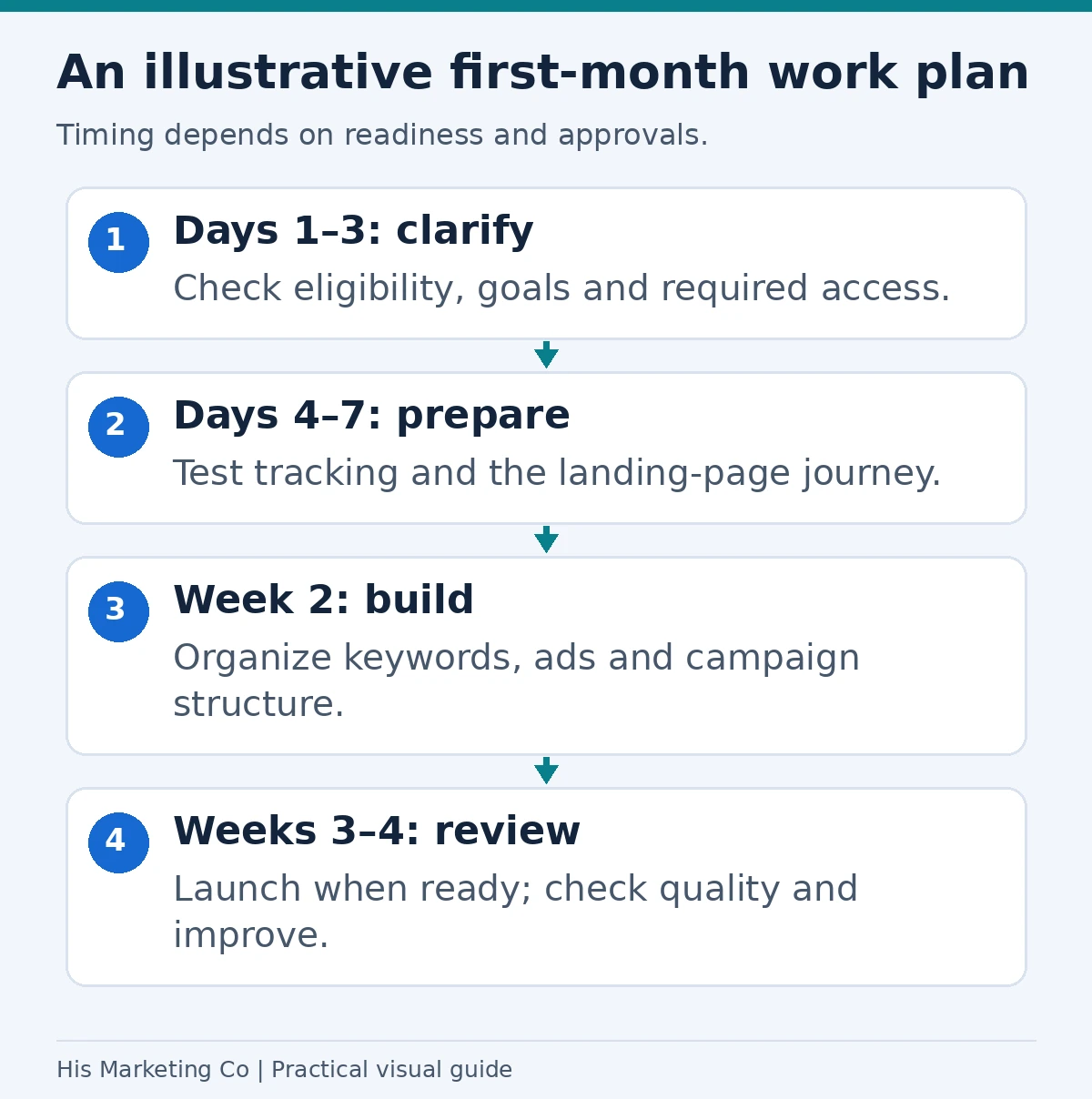
Illustrative work plan, not an approval deadline or donation-results promise. Complete readiness and approval requirements before launch; use early data to check traffic and meaningful actions.
The first 30 days should create a measurable fundraising system, not just turn on ads.
Days 1 to 3, eligibility and goals
- Confirm Google Ad Grant eligibility.
- Choose one primary outcome, such as completed donations.
- Define secondary outcomes, such as recurring gifts or volunteer applications.
- Record the baseline for donations, average gift, and conversion rate.
Days 4 to 7, tracking and landing page
- Test the donation flow on desktop and mobile.
- Install or verify conversion tracking.
- Create a dedicated donation landing page.
- Confirm that the thank-you page fires one completed-donation event.
- Document the transaction value and donor source.
Week 2, keyword and campaign build
- Group keywords by intent and landing page.
- Add negative keywords.
- Write responsive search ads.
- Set geographic and language targeting.
- Create a campaign for donations before expanding to secondary goals.
Week 3, launch and quality control
- Review policy compliance.
- Check search terms daily during the first few days.
- Remove irrelevant queries.
- Confirm that ads, pages, and conversions match.
- Check for broken links and mobile form issues.
Week 4, optimize for meaningful actions
- Compare clicks with completed donations.
- Review donation conversion rate by campaign and query theme.
- Improve the weakest landing page section.
- Pause keywords that create irrelevant traffic.
- Identify one paid Google Ads test if the grant campaign shows measurable intent.
At the end of 30 days, publish a short performance report. Include spend or grant utilization, impressions, clicks, completed donations, donation value, conversion rate, recurring donors, and next actions.
Conclusion, the practical next step
Google Ads can be a strong donation channel because it reaches people who already express a need or cause interest. The Google Ad Grant can reduce the media-cost barrier for eligible nonprofits, but it does not replace strategy or stewardship.
Start with one donation goal, one focused landing page, one reliable conversion, and a tightly organized keyword set. Validate the account during the first week. Launch the core campaign in week two. Optimize search terms and landing-page friction in weeks three and four. Then compare the grant with a small paid campaign and other channels using completed donations, donor value, and recurring-gift quality.