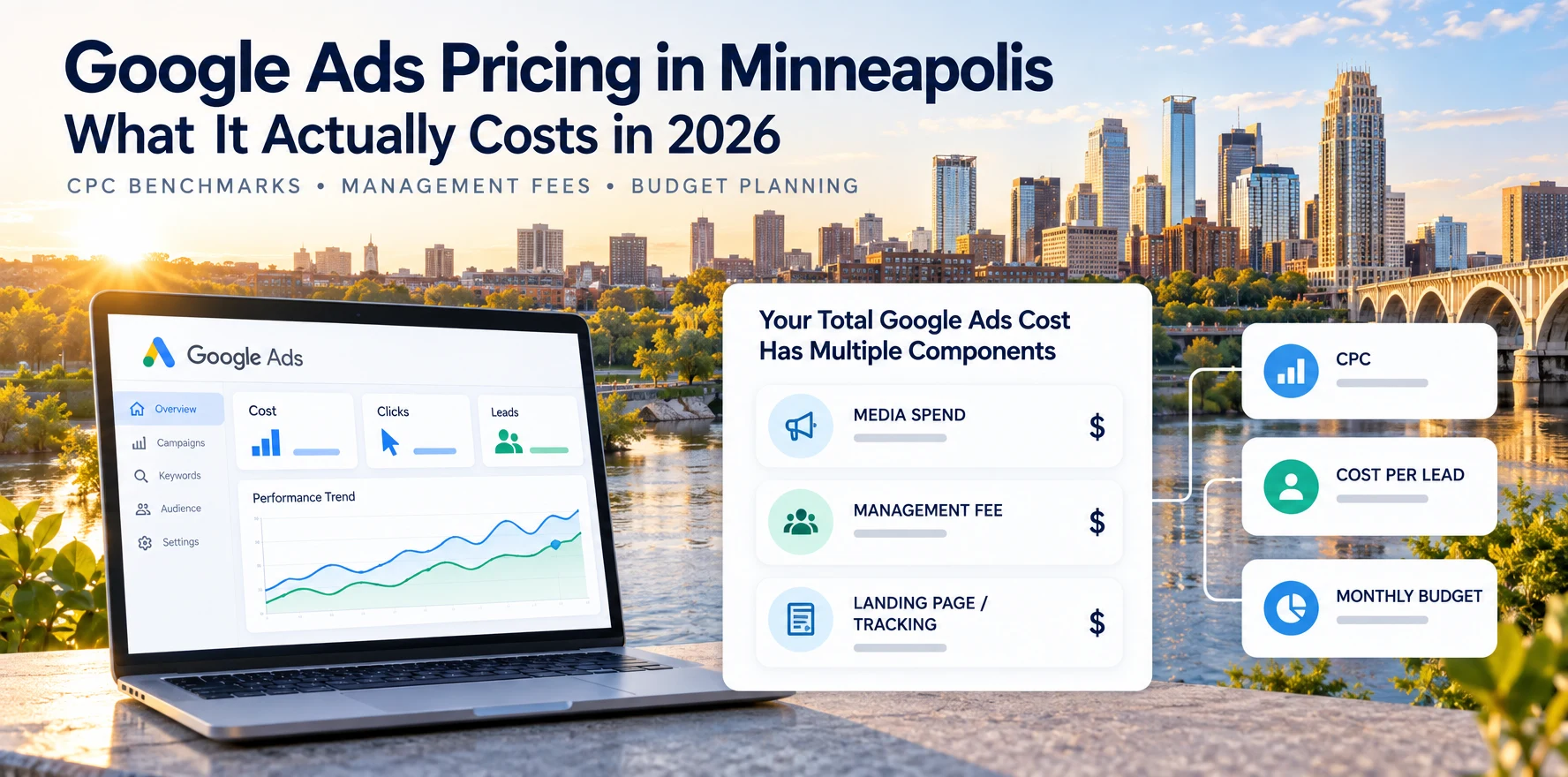
Direct answer
Google Ads management for a Minneapolis business has two main costs: what you pay Google for the traffic and what you pay someone to manage the account. National 2026 search benchmarks put average cost per click at $5.42, while higher-cost categories such as legal services and home improvement can run around $8 to $10 per click, and percentage-based agency management commonly falls in the 10% to 20% of ad spend range.
The useful budget is not a generic Minneapolis number. I would build it from your industry's click costs, the number and value of qualified leads you need, and the amount of work required for tracking, landing pages, reporting, and account management.
Key takeaways
- The 2026 U.S. average Google Search CPC is $5.42 across 13,474 campaigns. WordStream/LocaliQ benchmark summary
- Higher-cost categories include attorneys and legal services at $9.87, home improvement at $8.33, and dental services at $8.00 per click. Focus Digital 2026
- Percentage-of-spend Google Ads management commonly runs around 10% to 20%, usually with minimum fees or other pricing structures depending on scope. ALM Corp 2026
- Google Ads budget should be based on business goals and what you are comfortable spending, not a universal daily-budget formula.
- Quality Score is useful for diagnosing keyword, ad, and landing-page relevance, but Google says the 1-to-10 score itself is not an input in the ad auction.
- A low budget is not automatically wrong, but a budget that buys too little traffic to evaluate results can make it difficult to tell whether a campaign is working.
- Management fees should be evaluated alongside tracking, landing-page work, CRM integration, reporting, and strategic involvement, not just as a percentage of media spend.
What does Google Ads pricing actually include?
When someone asks me what Google Ads costs, I separate the answer into three buckets.
The first is media spend. That is the money paid directly to Google when people click or otherwise interact with the ads.
The second is management. That can include campaign structure, keyword research, search-term reviews, negative keywords, ad testing, bidding, conversion tracking, reporting, and ongoing optimization.
The third is supporting work. Depending on the account, that can include landing pages, call tracking, CRM integration, offline conversion imports, analytics cleanup, or creative work.
Those categories matter because two Minneapolis businesses can spend the same amount with Google and still have very different total costs. One may already have clean tracking and strong landing pages. Another may need the entire measurement and conversion path rebuilt before paid traffic can be evaluated properly.
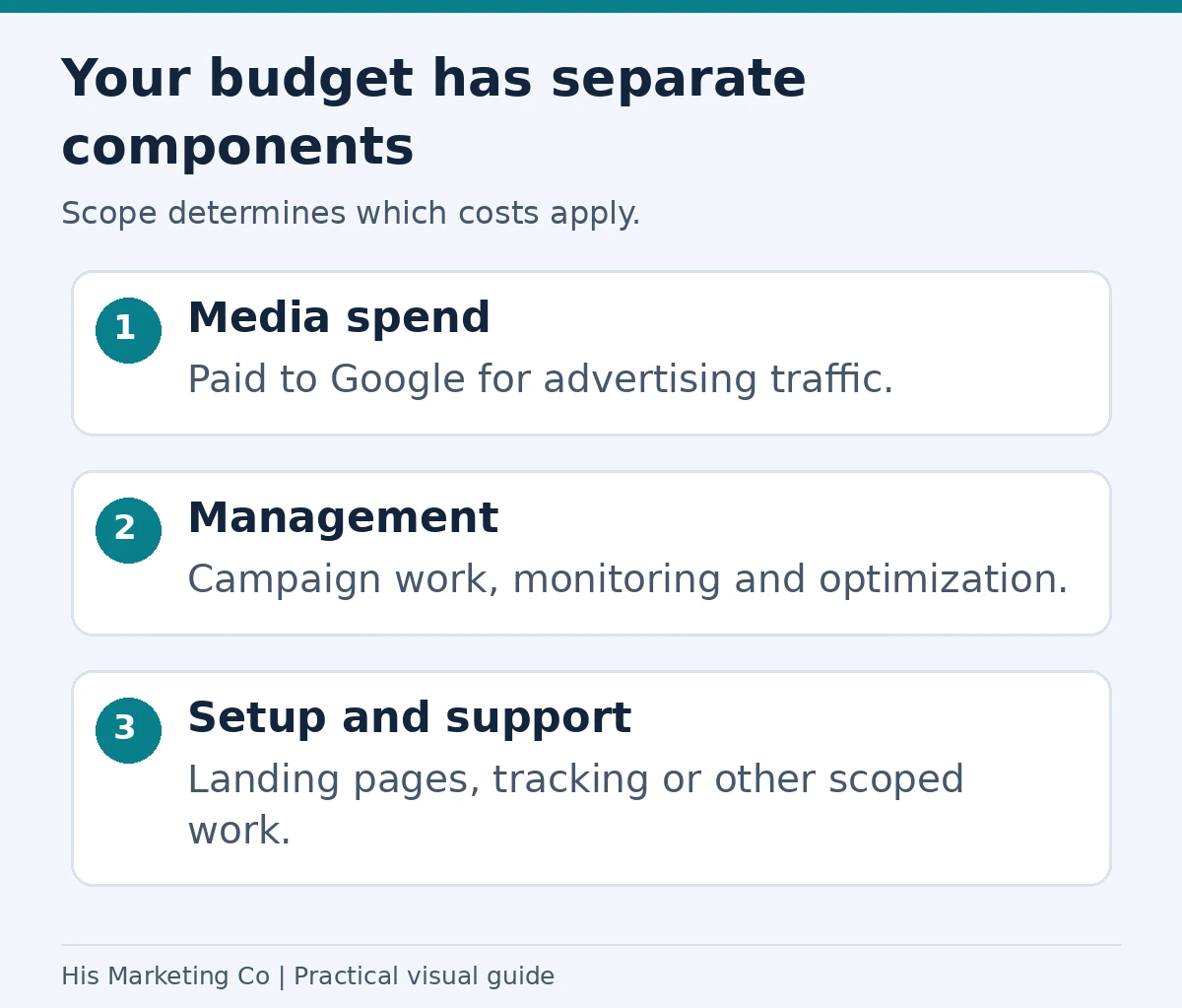
Separate advertising spend from management and any setup, landing-page or tracking work. Some work is recurring; some is a project cost. Confirm the actual scope and fees.
How much does Google Ads cost per click in Minneapolis?
There is no single Minneapolis cost-per-click rate.
Google Ads works through auctions, and the price of a click varies based on the search, competition, advertiser bids, ad quality, user context, and other auction-time signals. National industry benchmarks are useful for planning, but they are not a guaranteed Minneapolis price.
WordStream and LocaliQ's 2026 benchmark report, covering 13,474 U.S. search campaigns across 23 industries from April 2025 through March 2026, puts the cross-industry average at $5.42 per click.
Focus Digital's 2026 analysis reports substantial differences by category:
| Industry | Average CPC | Year-over-year change |
|---|---|---|
| Attorneys & legal services | $9.87 | +15.0% |
| Home & home improvement | $8.33 | +6.1% |
| Dentists & dental services | $8.00 | +1.9% |
| Finance & insurance | $3.39 | -2.0% |
| Real estate | $3.22 | +27.3% |
Those differences are why I would not budget a Minneapolis roofing company the same way I would budget a real estate company or a financial-services firm.
A $500 monthly budget in a category averaging roughly $8 to $10 per click may only buy around 50 to 60 clicks before accounting for normal variation. That is not automatically too little, but it gives you much less data to judge targeting, search intent, lead quality, and conversion performance.
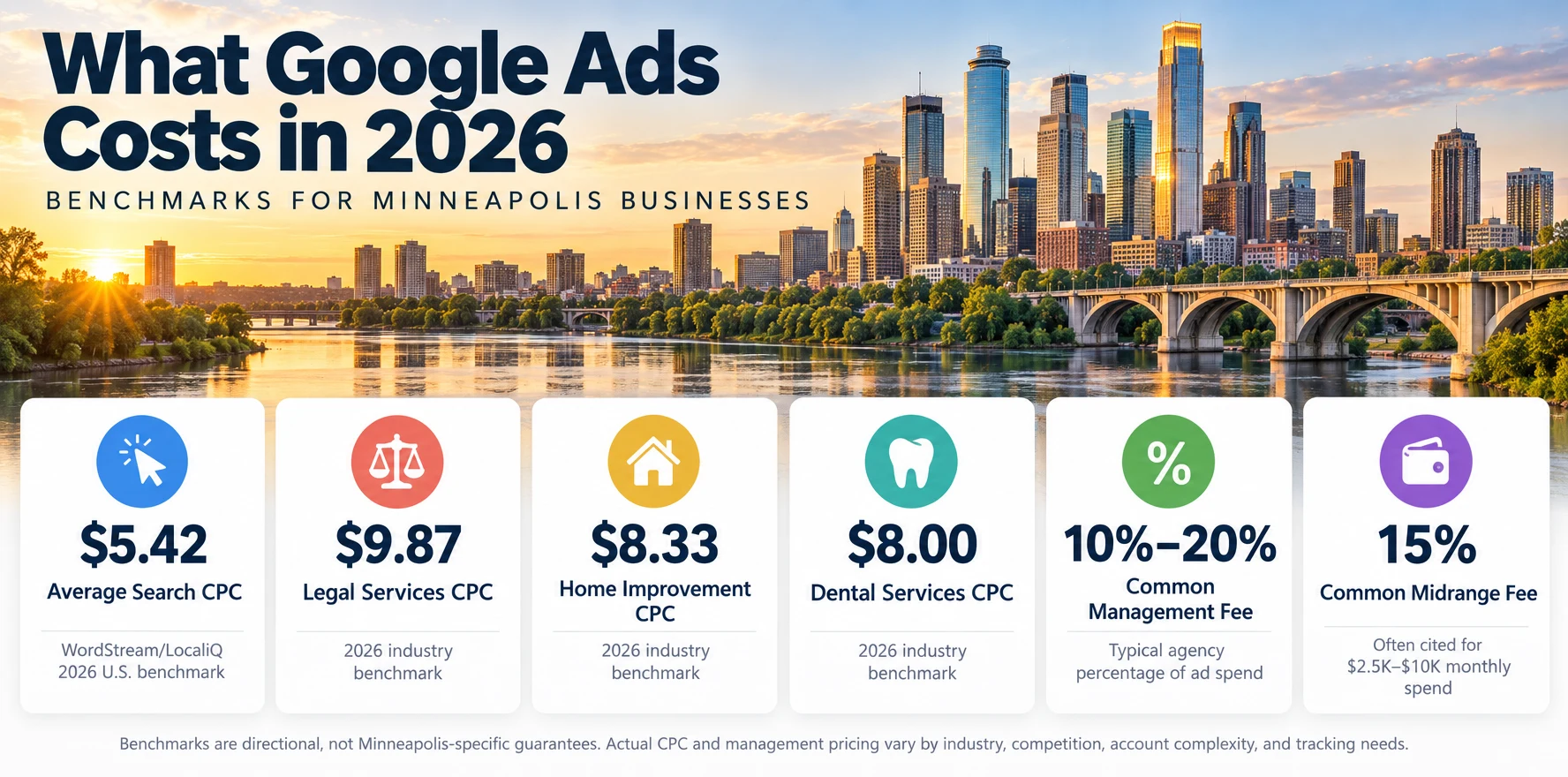
The graphic summarizes cited U.S. benchmarks and general fee models, not measured Minneapolis-specific costs. Actual prices vary by business, market and scope.
What do Google Ads management services cost?
Google Ads management can be priced several ways.
ALM Corp's 2026 pricing overview lists flat monthly retainers, percentage-of-spend pricing, hybrid arrangements, hourly consulting, and one-time project or setup fees as common approaches.
Its broader market ranges include:
| Pricing model | Reported 2026 range |
|---|---|
| Percentage of ad spend | Commonly 10% to 20% |
| Freelancers or solo consultants | Roughly $500 to $3,000/month |
| Smaller specialized agencies | Roughly $750 to $3,500/month |
| Mid-size agencies | Roughly $1,500 to $5,000+/month |
| Larger or enterprise agencies | Often $3,000 to $10,000+/month |
| Hourly consulting | Often $100 to $250/hour |
| One-time setup or onboarding | Often $500 to $5,000+ |
Those ranges are market benchmarks, not a His Marketing Co rate card.
The lowest management price is not necessarily the lowest total cost. A cheap account-management fee can become expensive if conversion tracking is wrong, qualified leads are not distinguished from spam, or the landing page is wasting paid traffic.
That is why I would ask what is included before comparing two Google Ads management quotes.
If you want an actual scope and quote for your account, book a strategy call.
What should a Google Ads management fee include?
For a local lead-generation account, I would expect the management conversation to cover more than changing bids once a month.
Depending on the account, the work may include:
- Campaign and ad-group structure
- Keyword and search-term analysis
- Negative-keyword management
- Geographic targeting
- Ad copy and asset testing
- Conversion tracking
- Call tracking
- Landing-page recommendations
- Bid and budget management
- Lead-quality review
- CRM or offline conversion integration
- Reporting and strategy
That list explains why a percentage of ad spend is only one way to price management. A $2,000-per-month account with complicated CRM tracking can require more work than a larger account with clean data, established campaigns, and strong landing pages.
To see how that work applies to your account, explore what my Google Ads management includes.
How should you calculate a Google Ads budget?
I prefer to work backward from the economics of the business.
A useful planning framework is:
Desired qualified leads × acceptable cost per qualified lead = planning budget
If a business wants 20 qualified leads and can profitably spend $75 to acquire each one, the planning number is $1,500.
That does not guarantee 20 leads. It gives you a business target against which the campaign can be evaluated.
The next step is to compare that target with likely click costs.
For example, if clicks in your category are around $8 each, a $1,500 media budget represents roughly 187 clicks before normal auction variation. If the category is closer to $3 per click, the same budget can buy substantially more traffic.
The important question is whether the amount of traffic you can realistically buy gives the campaign enough opportunity to produce and measure qualified leads.
Google itself does not require a universal "$30 per day," "$100 per day," or "five times your CPC" rule. Your average daily budget is the amount you are comfortable spending on average, and Google uses that budget to manage campaign spend over time.
For most campaigns, Google says a campaign can spend up to twice its average daily budget on a particular day when traffic is stronger, while the monthly spending limit is normally 30.4 times the average daily budget.
That means a $50 average daily budget corresponds to a normal monthly spending limit of about $1,520.
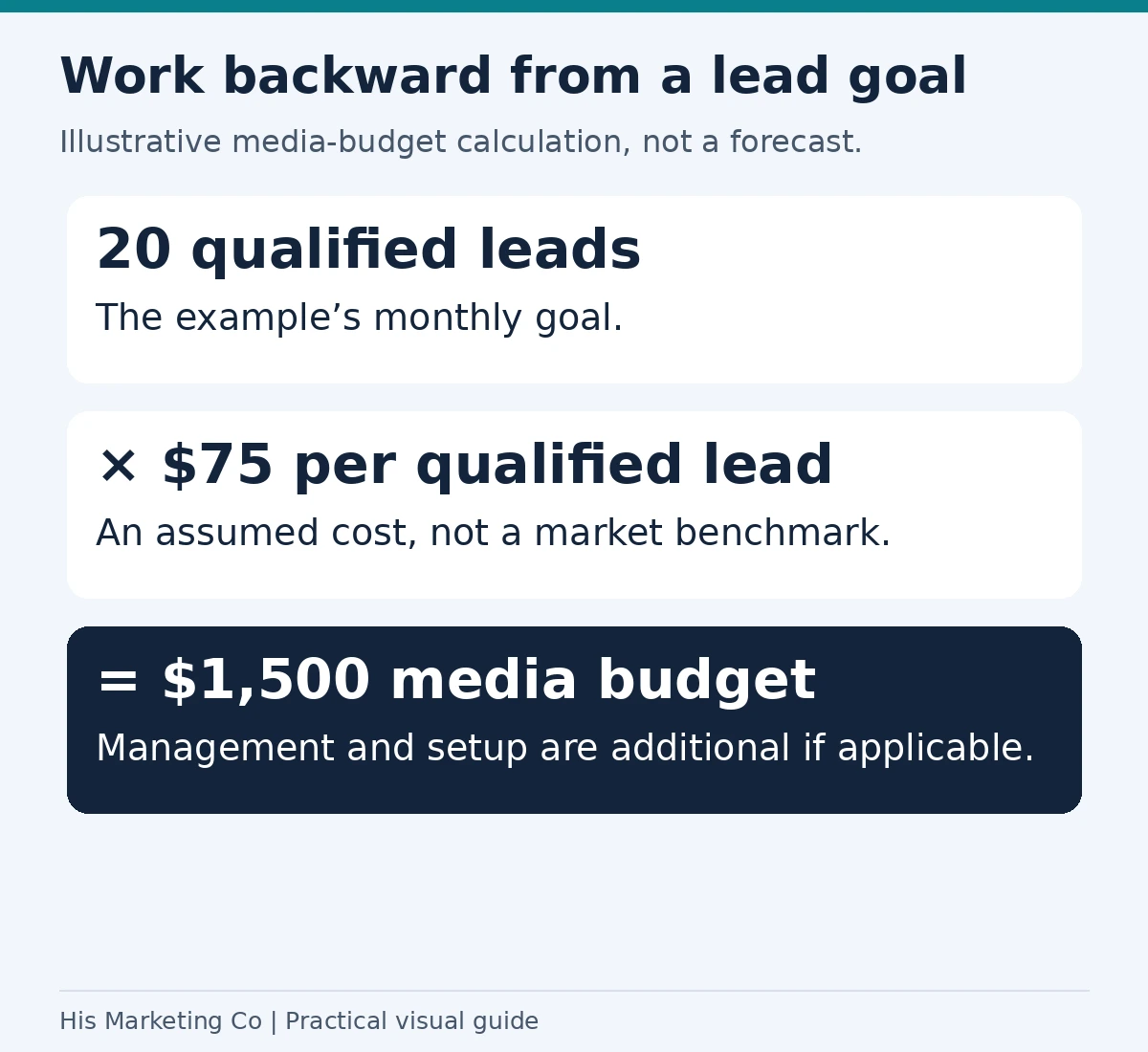
Illustrative calculation: 20 qualified leads × an assumed $75 cost per qualified lead = $1,500 in media spend. This is not a Minneapolis benchmark or a forecast, and it excludes management and setup fees.
Does Smart Bidding require a certain number of conversions?
I would not use a universal "you need 15 conversions" or "you need 30 conversions" rule for every account.
Google's current Smart Bidding options include Maximize Conversions, Target CPA, Maximize Conversion Value, and Target ROAS. The right strategy depends on the business goal, conversion setup, account history, and whether the account measures conversion value.
What matters most is giving Google accurate conversion signals.
If the account counts page views, button clicks, spam forms, and qualified sales opportunities as if they are equally valuable, additional conversion volume can actually make optimization worse.
I would rather have fewer accurately measured business outcomes than a larger volume of weak or misleading conversion actions.
That is why lead tracking and lead qualification are part of the budget discussion, not separate technical details.
How does Quality Score affect Google Ads costs?
Quality Score is often explained too simplistically.
Google describes the 1-to-10 Quality Score as a diagnostic tool that compares the relevance and usefulness of your ad experience with other advertisers. It is based on expected clickthrough rate, ad relevance, and landing-page experience.
Google also explicitly says that the displayed Quality Score itself is not an input in the ad auction.
That means I would not tell a Minneapolis business that moving from a Quality Score of 4 to 8 will automatically reduce CPC by a fixed percentage.
The useful takeaway is different: the underlying factors Quality Score helps diagnose still matter.
If the keyword, ad, and landing page do not line up with what the searcher wants, the account can have problems with engagement, conversion rate, and auction performance. Improving that experience can make the campaign more efficient, but there is no universal "50% CPC savings" formula I would use for planning.
For a deeper troubleshooting process, see Why Are My Google Ads Getting Clicks but No Leads?.
Do Minneapolis Google Ads prices differ from other markets?
They can.
Industry benchmarks are useful because legal searches usually behave differently from dental, real estate, or home-improvement searches. But the auction is not based on industry alone.
Google uses auction-time context, and competition can differ based on the particular query, location, device, time, audience, and advertisers participating in that auction.
So I use national benchmarks as a starting point, not as proof of what a Minneapolis click will cost.
The better answer comes from the actual keywords, service area, campaign history, and search terms in the account.
What is a realistic first-month Google Ads budget?
There is no single first-month budget I would recommend to every Minneapolis business.
A realistic starting point needs to answer four questions:
- What does a click typically cost in this category?
- What is a qualified lead worth?
- How many qualified leads would make the campaign meaningful?
- How much traffic can the available budget realistically buy?
If the budget is so small that the account only receives a handful of relevant clicks, it can take much longer to learn whether the offer, targeting, ad copy, and landing page are working.
That does not mean the solution is automatically to spend more. Sometimes the right move is to narrow the service area, focus on fewer high-intent services, remove expensive low-priority keywords, or improve the landing page before increasing spend.
Should you use a flat fee or percentage-of-spend agency?
Neither model is automatically better.
A flat fee can make costs predictable and can work well when the management workload is relatively stable.
Percentage pricing can make sense when account complexity and management work genuinely increase as spend grows.
A hybrid model can combine a minimum base fee with a smaller percentage of media spend.
I would compare the actual scope rather than choosing based on fee structure alone.
Ask whether the engagement includes tracking, landing-page recommendations, lead-quality analysis, reporting, strategy calls, account cleanup, and CRM or offline-conversion work when those are needed.
What should you do before increasing your Google Ads budget?
Before spending more, I would check whether the account is measuring the right outcome.
Make sure calls and forms are being tracked correctly. Review actual search terms. Confirm geographic targeting. Look at whether the landing page matches the ad promise. Separate qualified leads from spam or wrong-fit inquiries.
Then compare the cost of the traffic with the economics of the business.
If your campaign is already producing qualified leads at an acceptable cost, increasing budget can be a scaling decision.
If it is producing clicks but few useful leads, adding more money can simply buy more of the same problem.
The broader Google Ads for Minneapolis Businesses guide covers targeting, tracking, troubleshooting, landing pages, local SEO, and channel strategy in one place.
If you want me to review your current account and budget assumptions, contact His Marketing Co or book a strategy call.
Methodology
The CPC figures in this guide come from the 2026 WordStream/LocaliQ U.S. search benchmark data summarized by TheeDigital and Focus Digital's 2026 industry CPC analysis.
Agency management pricing ranges come from ALM Corp's 2026 overview of Google Ads management pricing.
Google Ads platform guidance on budgets, Smart Bidding, and Quality Score comes from current Google Ads Help documentation.
These are third-party and platform benchmarks, not His Marketing Co client results or published His Marketing Co pricing. Actual Minneapolis CPCs, lead costs, and management scopes vary by industry, search competition, targeting, account structure, tracking requirements, and business goals.