Direct answer
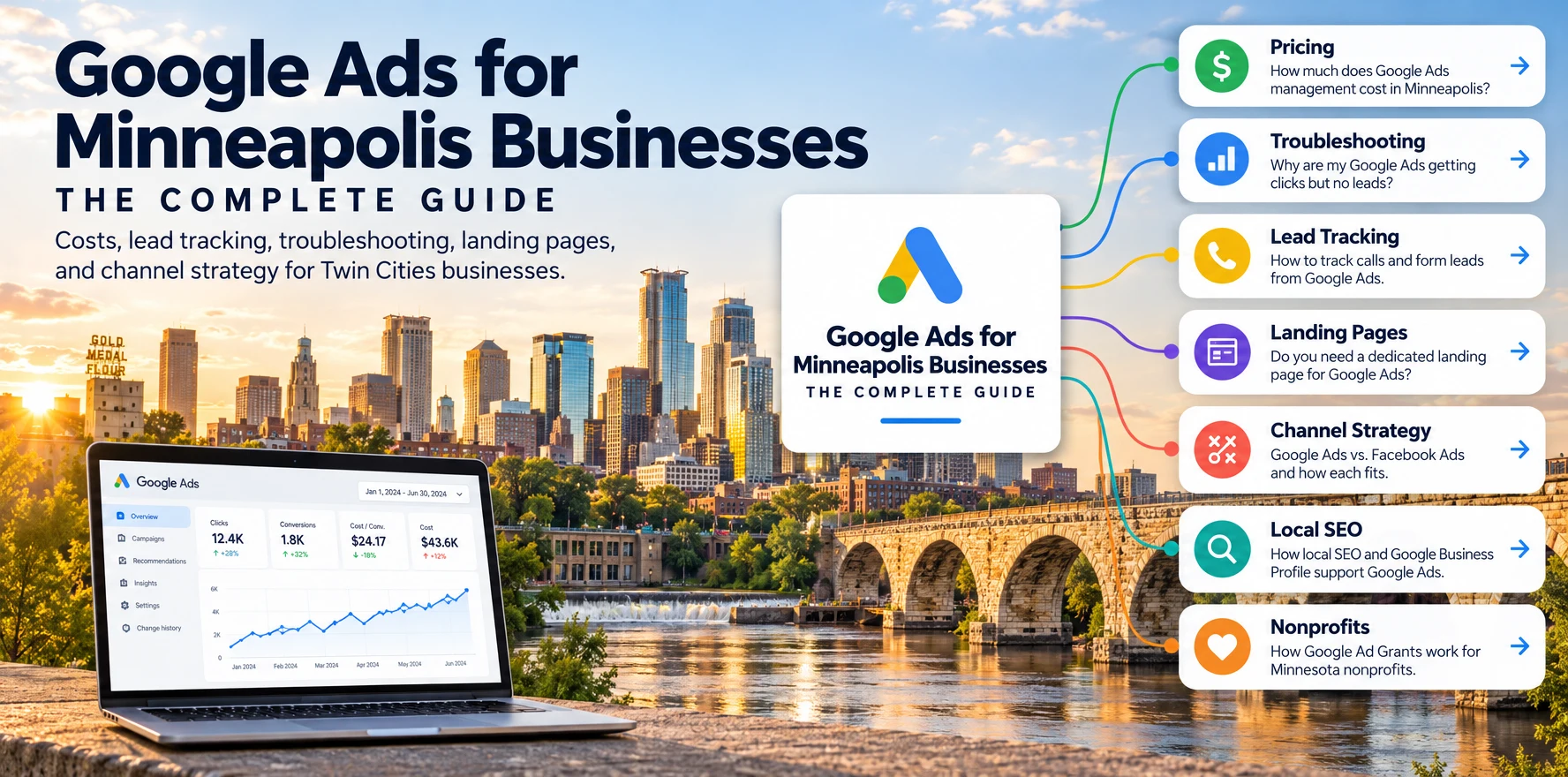
Google Ads for Minneapolis businesses works best when the account is built around local search intent, accurate lead tracking, realistic cost-per-click expectations, and landing pages that match what the ad promised. I use this guide to answer the main questions Twin Cities business owners run into when deciding what to spend, diagnosing campaigns that are not generating leads, tracking qualified opportunities, and choosing how Google Ads fits alongside SEO and other channels.
Key takeaways
- The national average Google Ads cost per click is $5.42 across 13,474 U.S. search campaigns, but categories such as legal services ($9.87) and home improvement ($8.33) run well above that. WordStream/LocaliQ 2026 Benchmarks, Focus Digital 2026
- Most Google Ads management agencies charge 10% to 20% of monthly ad spend, with 15% common for accounts in the $2,500 to $10,000/month range. ALM Corp 2026
- Clicks are not enough. Call tracking, form tracking, CRM qualification, and offline conversion imports help Google Ads optimize toward leads that are actually valuable.
- Dedicated landing pages usually give paid-search visitors a clearer path to convert than a general homepage.
- Local SEO and Google Business Profile support the same local-search ecosystem, but they solve a different problem than paid search.
- Google Search and Meta Ads capture different levels of intent, so I treat them as complementary channels rather than interchangeable ones.
- Eligible nonprofits can use Google Ad Grants for up to $10,000 per month in Google Search advertising, under a different set of account rules.
What does it take to run Google Ads for a Minneapolis business?
A working Google Ads account for a Twin Cities business comes down to three things I see self-managed accounts get wrong most often: keyword structure built around local intent instead of generic head terms, conversion tracking tied to actual leads instead of page views, and a budget that reflects what the business's industry really costs per click.
That sounds simple. In practice, it is where local accounts often leak money. Broad keywords can pull in searches that are not commercially useful. Geographic settings can expose campaigns beyond the intended service area. A contact-page visit can be counted as a conversion even though nobody submitted a form. A $500 monthly budget can also disappear quickly when the category costs $8 to $10 per click.
This guide is the main hub for my Minneapolis Google Ads content. It covers what Google Ads costs, what causes campaigns to generate clicks without leads, how to track qualified leads, whether a dedicated landing page is necessary, how paid search relates to local SEO, how Google Ads compares with Meta Ads, and how the strategy changes for nonprofits.
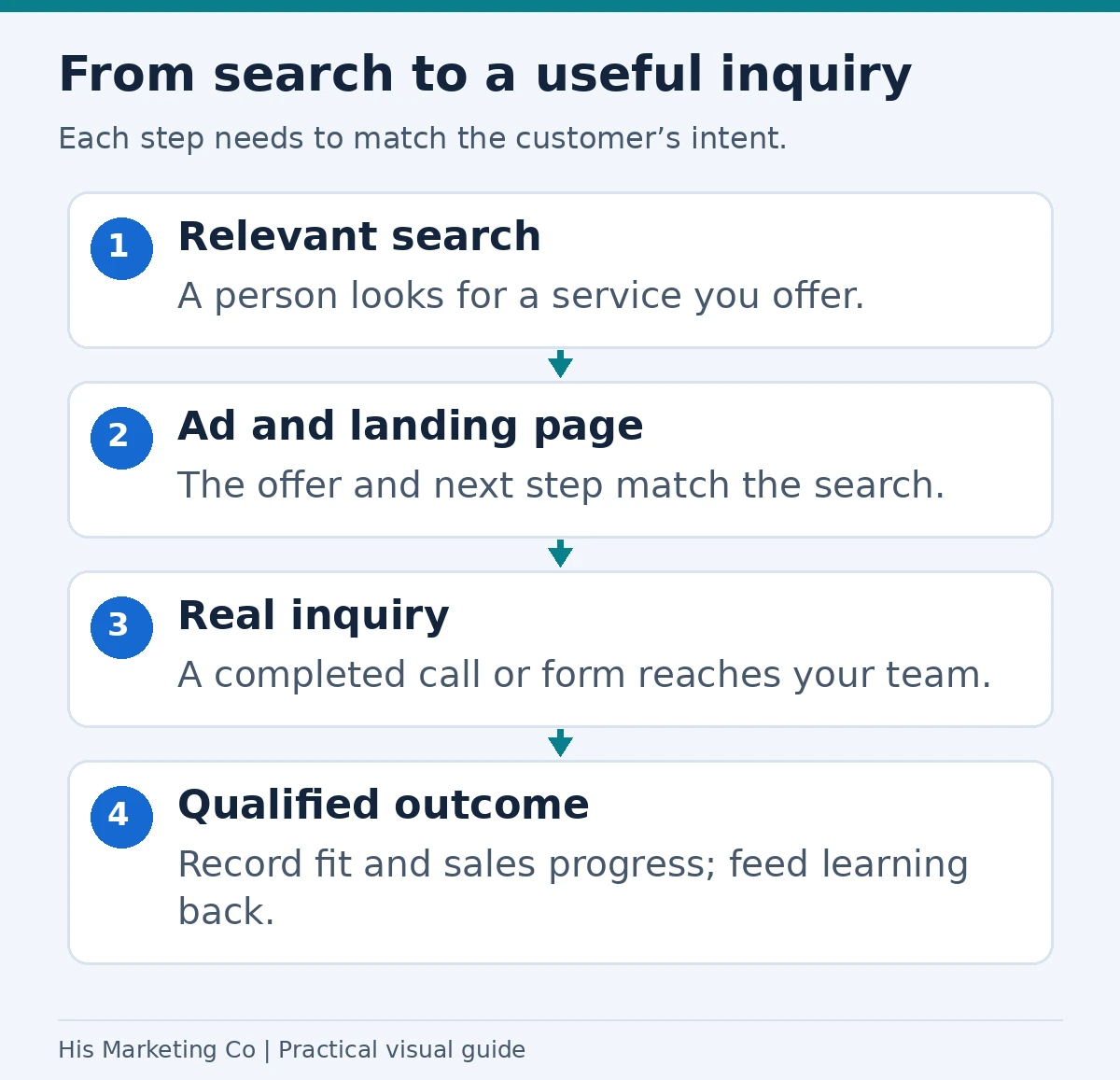
A useful workflow connects relevant searches, matching ads and pages, completed inquiries, and qualified outcomes. Use the outcome data to improve the campaign.
How much do Google Ads cost for a Minneapolis business in 2026?
Nationally, the average cost per click across Google Search sits at $5.42, based on WordStream and LocaliQ's 2026 report, which reviewed 13,474 U.S. search campaigns across 23 industries between April 2025 and March 2026. That is a national benchmark, not a Minneapolis-specific CPC, and the number varies substantially by category.
Focus Digital's 2026 analysis of roughly $1.2 billion in ad spend puts attorneys and legal services at $9.87 per click, home improvement at $8.33, dental services at $8.00, finance and insurance at $3.39, and real estate at $3.22.
Agency and freelancer management fees are a separate line item. ALM Corp's 2026 pricing breakdown puts many agencies at 10% to 20% of ad spend, or flat retainers that scale with account size:
| Monthly ad spend | Typical flat management fee |
|---|---|
| Under $2,500 | $300 to $1,000+ |
| $2,500 to $10,000 | $750 to $2,500+ |
| $10,000 to $50,000 | $1,500 to $6,000+ |
| $50,000+ | $4,000 to $10,000+ |
I do not publish a His Marketing Co price list here because account complexity, industry, tracking requirements, landing-page needs, and the amount of strategy involved all affect the actual scope.
If you want an actual quote instead of an industry range, book a free strategy call.
Full guide: How Much Do Google Ads Management Services Cost in Minneapolis? covers CPC benchmarks by industry, management-fee ranges, and a practical way to think about budget.
If you want help managing the account, explore my Google Ads management services for Minnesota businesses and clients nationwide.
Why do Google Ads get clicks but no leads?
When a Minneapolis Google Ads campaign gets traffic but produces few or no leads, I usually look at tracking, targeting, search intent, and the landing page before recommending more budget.
A campaign can appear to be working because it is generating clicks while still sending the wrong people to the site. It can also appear to be failing because the account is measuring the wrong conversion action.
Three issues are especially common in local accounts: conversion actions that count page loads instead of completed leads, geographic targeting that reaches people outside the intended market, and ads that send traffic to pages that do not closely match the searcher's intent.
Mateusz Makosiewicz, SEO & Marketing Educator at Ahrefs summarizes the keyword side well: "Focus on keywords that are less popular, more specific, and cheaper."
Before increasing spend, I would check whether the campaign is reaching the intended geography, whether the primary conversion action represents an actual lead, whether the search terms match the services being sold, and whether the landing page fulfills the promise made in the ad.
Full guide: Why Are My Google Ads Getting Clicks but No Leads? covers the complete diagnostic process and an ongoing maintenance checklist.
How do you track Google Ads leads and tell which ones are qualified?
Clicks and form fills are not the same thing as qualified opportunities.
A service business can generate dozens of submissions while still producing very little revenue if those leads are spam, outside the service area, looking for the wrong service, or unlikely to become customers.
That is why I want tracking to go beyond the initial conversion.
At minimum, the setup should connect phone calls and forms to their traffic source. Ideally, the business also records whether each lead became qualified, booked, sold, or disqualified. That information can then be passed back into Google Ads so bidding decisions are informed by business outcomes rather than raw form volume.
Rebecca Riserbato at HubSpot makes an important point about local conversion paths: "Your site should include contact information that is easy to find so there's no friction in the conversion process."
The practical setup can include call tracking, form conversion tracking, a CRM qualification stage, and offline conversion imports that tell Google Ads which leads ultimately mattered.
Full guide: How Do I Track Calls and Form Leads from Google Ads? covers call tracking, CRM qualification, and offline conversion imports.
Do Minneapolis businesses need a dedicated Google Ads landing page?
Not every campaign needs a completely separate website, but most distinct Google Ads offers benefit from a page designed specifically around the searcher's intent.
A general homepage has to serve many audiences. It might contain navigation, company information, multiple services, blog links, recruiting information, and several calls to action. Someone arriving from a paid search ad usually has a much narrower question.
A strong Google Ads landing page should closely mirror the service and promise in the ad, make the primary contact action easy to find, answer the objections that would stop someone from contacting the business, and remove unnecessary distractions.
The goal is not simply to make the page shorter. The goal is to make the path from search query to ad to landing page to lead feel consistent.
For a practical page-building checklist, see What Should a Minneapolis Service Business Include on Its Landing Page?.
How should local SEO and Google Business Profile fit alongside Google Ads?
I treat local SEO and Google Business Profile as supporting channels around Google Ads, not as substitutes for it.
Google Ads can put a business in front of someone who is actively searching now. Local SEO and Google Business Profile help improve unpaid visibility over time. A Twin Cities business can use both, but each channel should be measured according to the job it is doing.
VeloRank's 2026 audit of 1,058 Minnesota small-business websites found that 87.7% had no LocalBusiness schema markup and 41.3% had no visible phone number on the homepage. Those findings are useful beyond SEO because the same website weaknesses can reduce the value of paid traffic.
For that reason, I look at the website foundation when reviewing Google Ads. A strong campaign cannot fully compensate for a slow, confusing, or low-trust destination.
For practical steps on profile accuracy, service pages, reviews, and measurement, see my Twin Cities local SEO and Google Business Profile guide.
If you need broader marketing support beyond paid search, you can see the services I offer through His Marketing Co.
Google Ads or Facebook Ads: which role does each channel play?
Google Search Ads and Meta Ads usually reach people at different points in the buying process.
Google Search is built around an expressed query. Someone types what they need, and an advertiser competes to appear for that search. Meta is generally stronger at reaching audiences based on interests, behaviors, creative engagement, remarketing, and demand generation.
Stackmatix's 2026 comparison reports higher average conversion rates for Google Search than Meta in its data set, while Meta shows a lower average CPC.
| Metric | Google Search Ads | Facebook/Meta Ads |
|---|---|---|
| Average CPC | $2.80 to $4.50 | $0.60 to $1.20 |
| Average conversion rate | 4.2% to 6.8% | 1.8% to 3.5% |
| Average cost per lead | $45 to $85 | $18 to $40 |
| Primary intent | Capturing active search demand | Building and retargeting demand |
| Typical strength | Services people already search for | Awareness, creative offers, retargeting |
For a service business where prospects are already searching for a solution, Google Ads is often the channel I would evaluate first because the intent is explicit. Meta becomes especially useful when the strategy also needs awareness, visual creative, audience development, or remarketing.
The important point is that Meta is a comparison topic. Google Ads remains the core subject of this guide.
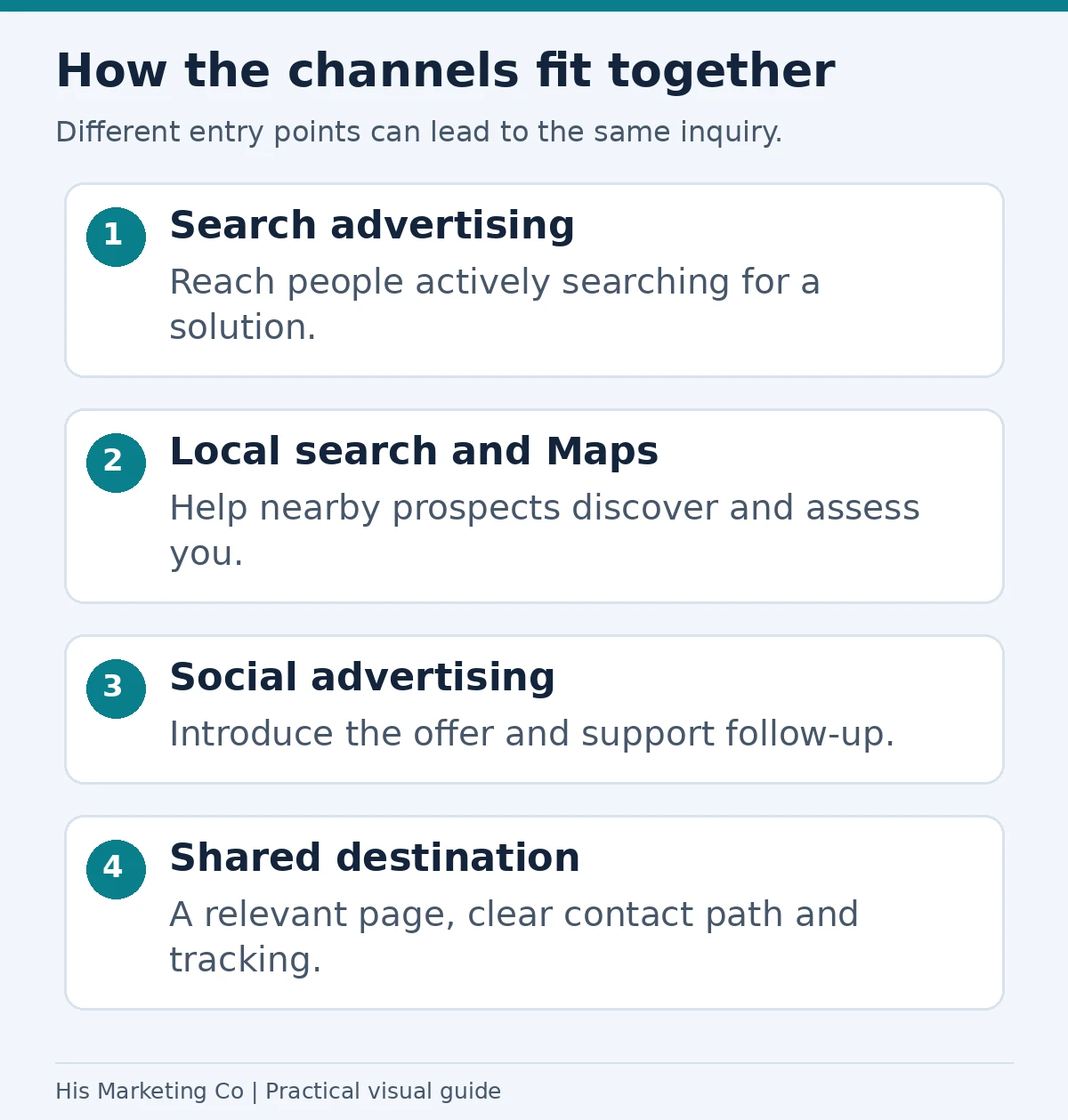
Search ads, local discovery and social ads can support different parts of the customer journey. Choose the mix around demand, the offer and meaningful outcomes, not a universal channel winner.
How is Google Ads different for Minnesota nonprofits?
For eligible nonprofits, Google Ads has an additional path that does not exist for a typical commercial advertiser.
Through the Google Ad Grants program, an approved 501(c)(3) nonprofit can receive up to $10,000 per month in Google Search ad spend under program-specific rules and restrictions.
Managing a Grant account is not the same as managing a standard paid Google Ads account. Keyword selection, conversion strategy, compliance, landing pages, and account structure all need to account for the program's requirements.
His Marketing Co works specifically with nonprofits on Google Ad Grants. You can learn more about Google Ad Grant management, including help with rejected accounts and strategies for turning search traffic into meaningful nonprofit actions.
What should a Twin Cities business do before spending more on Google Ads?
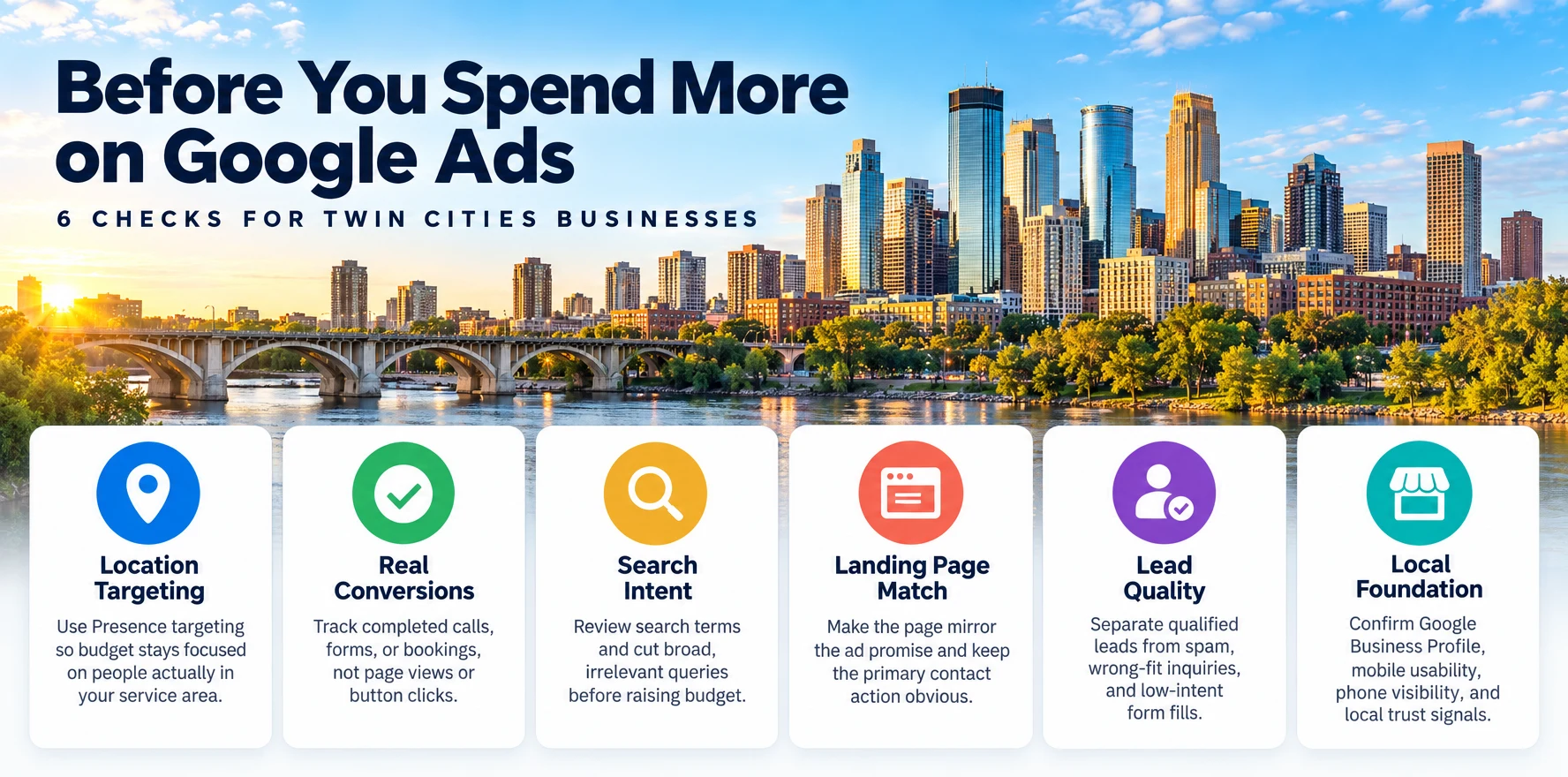
If you are starting from zero, I would first make sure the campaign can answer three questions: who are we trying to reach, what action counts as a real lead, and how much traffic can the budget realistically buy in this category?
Then I would set up conversion tracking before significant traffic starts arriving. Waiting until later means losing the data needed to understand which keywords, ads, and campaigns produced useful outcomes.
If you already have an account that is not performing, I would diagnose targeting, search terms, conversion tracking, and landing-page alignment before assuming the answer is simply a larger budget.
If you want to go deeper into a specific part of running Google Ads for a Minneapolis or Twin Cities business, these guides cover the most common questions I see:
- How Much Do Google Ads Management Services Cost in Minneapolis?
- Why Are My Google Ads Getting Clicks but No Leads?
- How Do I Track Calls and Form Leads from Google Ads?
As I publish the remaining guides on landing pages and related Google Ads decisions, I will add them here so this page remains the central hub.
If you want me to review the account itself, contact His Marketing Co or book a strategy call.
Methodology
Cost, conversion, and pricing figures in this guide are drawn from WordStream/LocaliQ's benchmark report covering 13,474 U.S. search campaigns from April 2025 through March 2026, Focus Digital's analysis of roughly $1.2 billion in Google Ads spend, ALM Corp's 2026 agency pricing breakdown, Stackmatix's Google-versus-Meta comparison, and VeloRank's August 2026 audit of 1,058 Minnesota small-business websites.
I cite figures at the point where they are used. These pricing and performance benchmarks are third-party data, not His Marketing Co client results. Where a source reports a range rather than a point estimate, I preserve that distinction.