Direct answer
To improve local SEO and Google Business Profile visibility in the Twin Cities, start with accurate business information, a profile that represents your real business, useful pages for the services you offer, and genuine customer reviews. Then measure whether that visibility produces inquiries you can actually serve.
I treat the profile and website as connected parts of the customer journey. Getting found is one job. Helping someone understand the offer and contact the business is another.
For a Minneapolis, St. Paul, or suburban service business, the starting point is clarity: what you do, where you work, and why a customer should choose you. There is no setting that guarantees a top-three Maps position across the entire metro.
What is the difference between local SEO and Google Business Profile?
Your Google Business Profile is the business listing people can encounter on Search and Maps. Local SEO is the broader work of making your business and website useful and discoverable for relevant local searches.
I separate the work into three areas:
| Area | What I would review | Business outcome to watch |
|---|---|---|
| Business Profile | Accuracy, categories, real photos, reviews, and contact links | Useful inquiries from the listing |
| Website | Service pages, location clarity, crawlability, and contact experience | Qualified calls, forms, and bookings |
| Local reputation | Accurate listings and genuine local relationships | Trust and relevant referral opportunities |
This is my planning framework, not a list of ranking factors with assigned weights. A complete profile does not compensate for a broken website form or an offer that does not match the search.
How does Google determine local rankings?
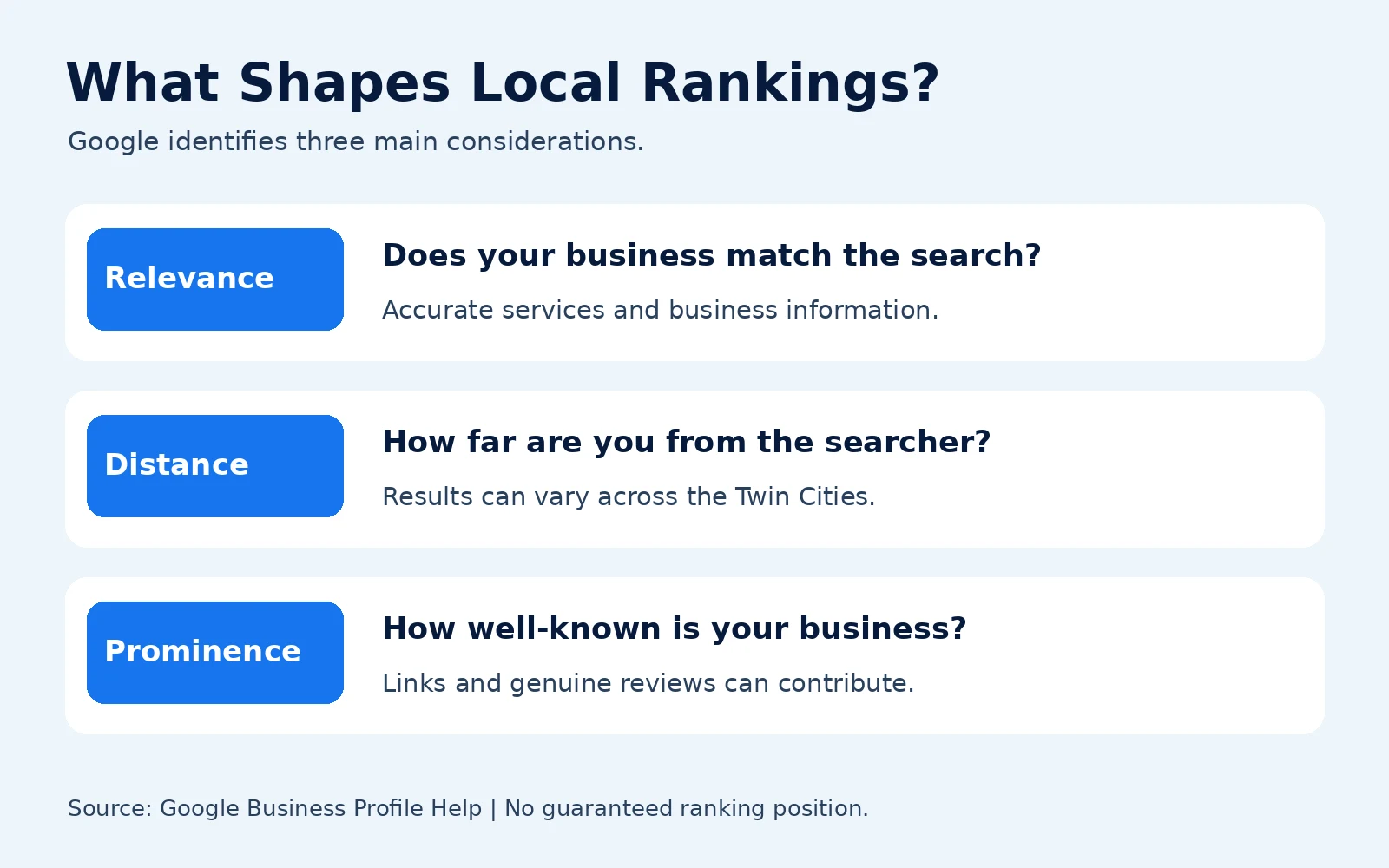
Google's local-ranking guidance identifies three main considerations:
- Relevance: How well the business matches the search.
- Distance: How far the business is from the searcher.
- Prominence: How well-known the business is, including signals such as links and reviews.
Google also says you cannot request or pay for a better local ranking. Advertising is a separate route to visibility.
For a Twin Cities business, that means a position seen near your location may differ from one seen across the metro. Check important services and realistic customer locations instead of treating one search from your own phone as a complete ranking report.
My recommendation is to improve the information and customer experience you control, then evaluate results in the areas you actually serve. A longer list of suburbs is not a substitute for that work.
1. Confirm eligibility and represent the business accurately
Before optimizing, check that the profile fits Google's business representation guidelines. Eligible businesses generally meet customers at a physical location or travel to them. Online-only businesses are not eligible simply because they want local leads.
Use the real-world business name. Do not append service keywords or city names unless they are genuinely part of that name. Choose a specific category that represents the core business, with only relevant additional categories.
A service-area business that does not receive customers at its address should hide that address. A rented mailing address is not a qualifying office. Google sets conditions for coworking locations, including signage, staffing, and receiving customers during business hours.
I would also check ownership and verification before making a long list of edits. Keep access under the business's control and resolve duplicate or suspended-profile issues through the appropriate support process. Do not create a replacement profile to evade a restriction.
2. Make the profile useful to a prospective customer
Review the customer-facing information as if you were deciding whether to contact the business:
- Are the service and business description accurate?
- Do the phone and website links work?
- Are hours and holiday changes current where applicable?
- Does the service area reflect actual coverage?
- Are photos genuinely of the business, team, location, or work?
- Is the next step clear when someone reaches the website?
For a business based in Eagan that serves only part of the metro, I would make that coverage understandable rather than claiming every Twin Cities location. Retail customers may need parking or entrance information; a traveling service provider may need to explain how scheduling works.
Use profile updates when you have useful news, such as a service change or a genuine offer. I do not treat a fixed posting frequency or geotagged-photo routine as a guaranteed ranking method.
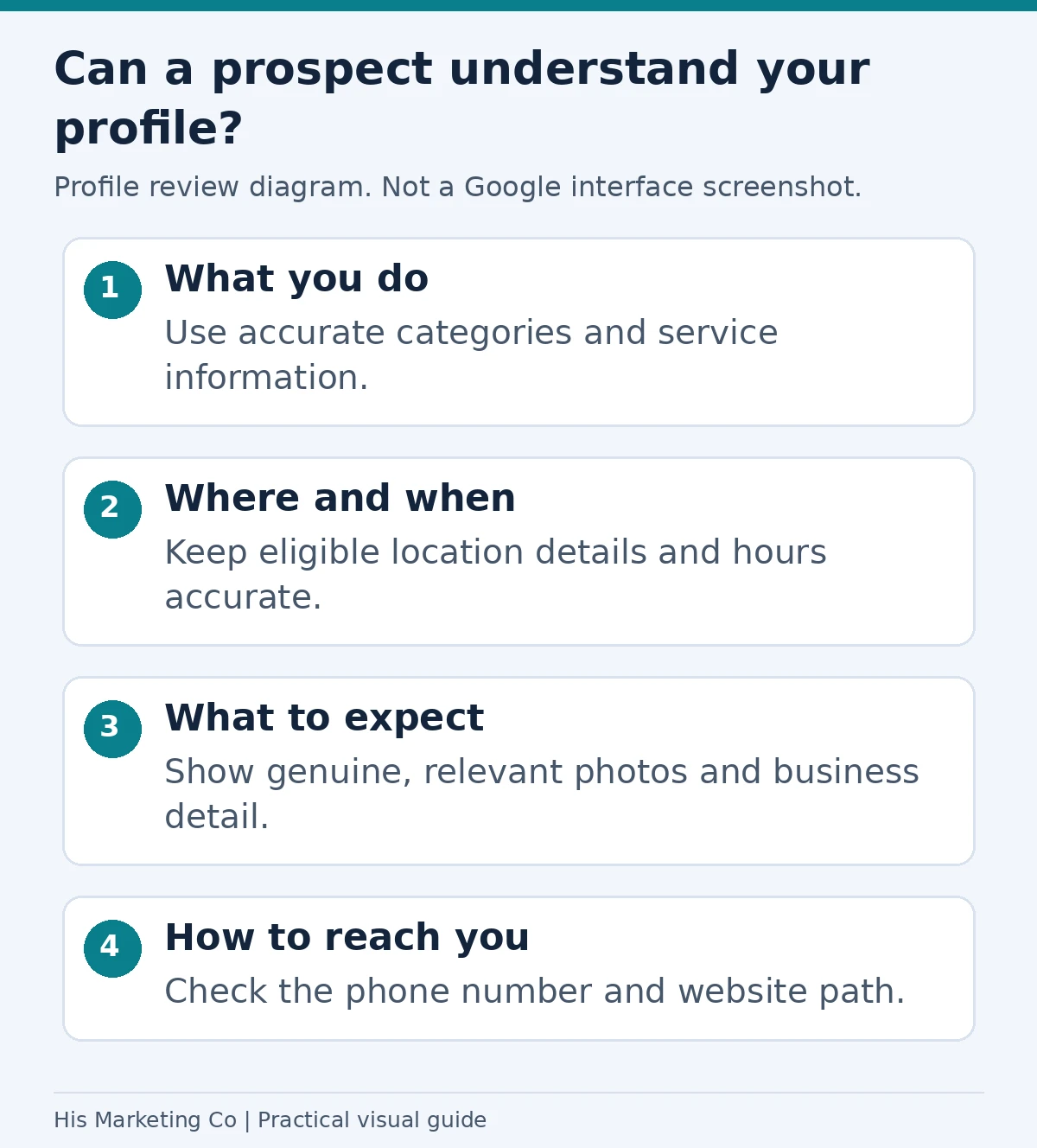
Profile-review diagram, not a screenshot: check service information, accurate location and hours, genuine photos, and the contact path. Use the fields available to your business type.
3. Connect local searches to useful service pages
Your website should explain the services people are evaluating. A broad page that lists everything you do may not answer a specific customer's question.
Start with your actual offers, then group searches by intent. An illustrative example for a home-service business might be:
| Search intent | Appropriate page content |
|---|---|
| Furnace repair in Minneapolis | Repair service, coverage, process, and contact options |
| Furnace installation in St. Paul | Installation scope, decision factors, and estimate process |
| Is this provider available in my suburb? | Clear service-area information and a way to confirm fit |
These are examples, not researched keyword-volume estimates or a recommendation that every business needs those pages.
Use Search Console, customer questions, and relevant search results to learn how people describe the need. Make titles and headings clear, then explain the service naturally. You do not need to repeat “near me” throughout the copy. Google's SEO Starter Guide supports descriptive page content and a structure people and search engines can navigate.
Keep local keyword selection as a deliberate research step. Do not assume every service-plus-city phrase deserves its own URL.
4. Add local detail without duplicating city pages
Useful local detail could include genuine work examples, actual coverage limits, a real location's contact information, or questions customers in that area regularly ask.
Changing “Minneapolis” to “St. Paul” or “Maple Grove” in otherwise identical copy rarely creates a more helpful page. Google's spam policies address doorway abuse, including similar regional pages that funnel visitors to the same destination.
Create a separate location page when there is meaningful information to explain, such as a real staffed location or genuinely distinct service details. Keep the website organized so visitors can browse the pages normally.
For the conversion side, use my landing-page checklist for Minneapolis service businesses. It covers clear offers, credible proof, service-area information, and usable contact paths.
5. Build genuine reviews and local credibility
Ask customers for honest feedback without trying to control the rating or wording. Google's review policies prohibit incentivized reviews and selectively soliciting positive reviews.
That means avoiding discounts for reviews, buying ratings, and sending only satisfied customers to Google while routing everyone else into a private feedback form. Use a neutral request and let customers describe their experience in their own words.
Respond helpfully and protect customer privacy. A review reply should address the situation, not become a paragraph of repeated service and city keywords.
For wider credibility, I would prioritize accurate information on relevant platforms and genuine business relationships. A legitimate association listing, supplier relationship, community involvement, or useful local resource may be worth pursuing because it helps people discover and assess the business. Avoid buying bulk links or directory packages solely for promised ranking gains.
6. Check the website foundation
Local content needs a working website behind it. My review would include:
- Important pages load and are available for indexing.
- Service pages are linked from the navigation or another relevant page.
- Page titles describe the content without stuffing city names.
- Contact details are current wherever they appear.
- Forms, phone links, and booking tools work on mobile.
- Search Console does not reveal an unresolved indexing issue on a priority page.
Structured data can describe verified business facts, but it should match the visible content. Google's LocalBusiness structured-data documentation explains the supported properties and requirements. Markup does not guarantee enhanced search appearances, and it does not justify inventing addresses or ratings.
If you hide a home address on a service-area profile, do not publish that private address in website markup simply to fill a field. Have the implementation reviewed for the actual business model and supported requirements.
7. Measure visibility, interactions, and qualified leads separately
Google's Business Profile performance documentation defines “calls” as clicks on the profile's call button. That is not proof of a connected call, appointment, or sale. Website clicks also do not prove that someone submitted a form.
The report can include interactions from organic results and Google Ads. Available metrics vary by business, so do not assume every total represents unpaid leads alone.
I would compare three layers:
| Measurement layer | What it helps answer |
|---|---|
| Visibility | Are relevant customers encountering the profile or website? |
| Interaction | Are people clicking through, requesting directions, or taking a contact action? |
| Business outcome | Did the inquiry become qualified, booked, or sold? |
Use clearly labeled campaign parameters on the profile's website link when appropriate, then test that the destination and analytics work. Compare that information with your actual call, form, and CRM records. Attribution can be incomplete, so do not force unlike metrics to match exactly.
My lead-tracking guide explains the distinction between initial inquiries and qualified outcomes. Its advertising-specific setup should not be treated as automatic attribution for every organic profile visit.
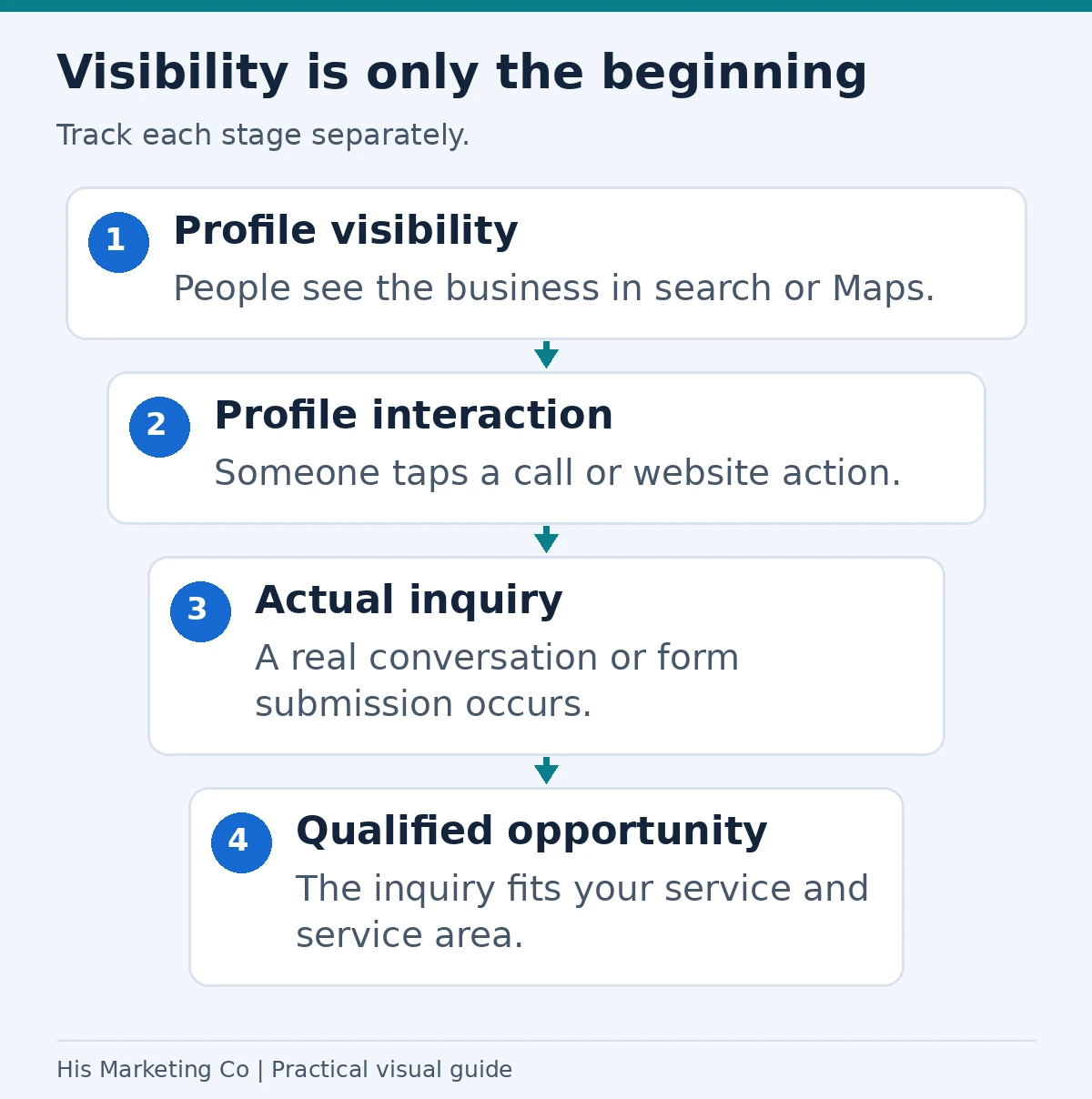
Visibility, interactions, actual inquiries and qualified opportunities are different measures. A call-button click does not by itself prove a completed or qualified call.
What if the profile is visible but not getting calls?
Separate a visibility problem from a conversion problem. Check whether people are seeing the profile for relevant services, whether the contact details work, and whether the website gives suitable prospects a reason to inquire.
Then review availability, service fit, reviews, and the real follow-up process. If call-button clicks exist but few conversations reach the business, test the phone route and check missed calls. If traffic reaches the website without inquiries, review the offer and contact experience.
That diagnosis deserves its own detailed article. For this overview, the key is to avoid assuming that “more SEO” is always the answer to missing calls.
What I would prioritize first
First, fix eligibility, access, or incorrect business details. Next, repair broken contact paths and clarify the service area. Then improve the highest-priority service pages, develop a neutral review-request process, and establish measurement.
Review results regularly with seasonal demand and business changes in mind. Do not promise a fixed ranking timeline or judge the whole strategy by a few searches from one location.
Local SEO can work alongside paid advertising. My Google Ads guide for Minneapolis businesses explains how the wider system fits together. Paid search should be assessed separately from organic visibility, with its own budget and measurement.
If you want help connecting your local presence, website, and lead generation, explore my marketing services. I am based in Minnesota and serve clients nationwide. Book a free strategy call to discuss your business and whether working together makes sense.
Methodology
I reviewed Google Business Profile and Search Central documentation on October 8, 2026. Platform requirements and metric definitions are linked where discussed. The prioritization framework and examples are my practical recommendations, not a Twin Cities ranking study or client case study. No keyword-volume figures, ranking guarantees, or performance benchmarks are claimed.