
Direct answer
Performance Max is one of the biggest changes to Google Ad Grants in years.
Nonprofits can now use Performance Max (PMax) alongside Search campaigns, giving Google more flexibility to find people who may be likely to donate, volunteer, register, call, visit, or take another meaningful action.
That does not mean every nonprofit should replace Search with PMax.
For many organizations, the stronger strategy is to use Search and Performance Max together, with each campaign type doing a different job.
The short answer
Performance Max can be a strong fit for Google Ad Grants when:
- you have clear conversion goals
- you have enough useful website content and landing pages
- Search campaigns are struggling to find enough volume
- you can provide meaningful audience signals and search themes
- you want to reach people beyond a fixed keyword list
- you are a local nonprofit that could benefit from Google Maps visibility
Google's current Ad Grants setup guide explicitly allows nonprofits to create either Performance Max or Search campaigns. Google describes PMax as especially suitable when you have specific conversion goals such as donations or volunteer signups.
Jason King, a Google Ad Grants Diamond Product Expert, also recommends testing PMax because it can sometimes spend more easily than a traditional Search campaign in an Ad Grant account.
Quick decision point: If you already know the exact searches you want to capture, keep Search as a core campaign. If demand is harder to predict or Search is struggling to spend, PMax is worth testing alongside it.
What is Performance Max in Google Ad Grants?
Performance Max is a goal-based Google Ads campaign type that uses Google's automation to find people likely to complete the actions you care about.
Unlike a normal Search campaign, you do not build PMax around a traditional keyword list. Instead, you give Google inputs such as conversion goals, landing pages, audience signals, search themes, creative assets, and geographic targeting.
Google then uses those signals to decide when and where the campaign should enter eligible auctions.
In a standard paid Google Ads account, PMax can use a wide range of Google inventory. In an Ad Grant account, current practitioner guidance indicates the available inventory is more limited, with Search and Google Maps being especially relevant.
Why did Performance Max matter so much for Google Ad Grants?
For years, Ad Grants was essentially a Search-only program. That meant nonprofits had to predict what people were going to search and build keyword structures around those queries.
That works well when search demand is obvious, such as:
- food bank near me
- volunteer with animals
- domestic violence help
- donate to veterans
But many nonprofit missions do not fit neatly into high-volume keywords.
PMax gives Google more flexibility to use your conversion goals, audience signals, search themes, landing pages, and assets to discover relevant demand instead of relying only on a keyword list.
Jason King describes this as one of the biggest changes to the Ad Grants program because nonprofits can define the type of audience and action they want without trying to predict every possible search term.
Performance Max vs. Search in Google Ad Grants
The two campaign types solve different problems.
| Search | Performance Max |
|---|---|
| Built around keywords | Built around goals, signals, assets, and automation |
| More control over search intent | More freedom for Google to discover demand |
| Easier to understand why traffic occurred | Less direct control over exact queries |
| Strong for known high-intent searches | Strong when demand is harder to predict |
| Great for tightly matched landing pages | Useful when several pages or actions may be relevant |
| Does not create Google Maps reach in the same way | Can support Google Maps visibility for eligible local nonprofits |
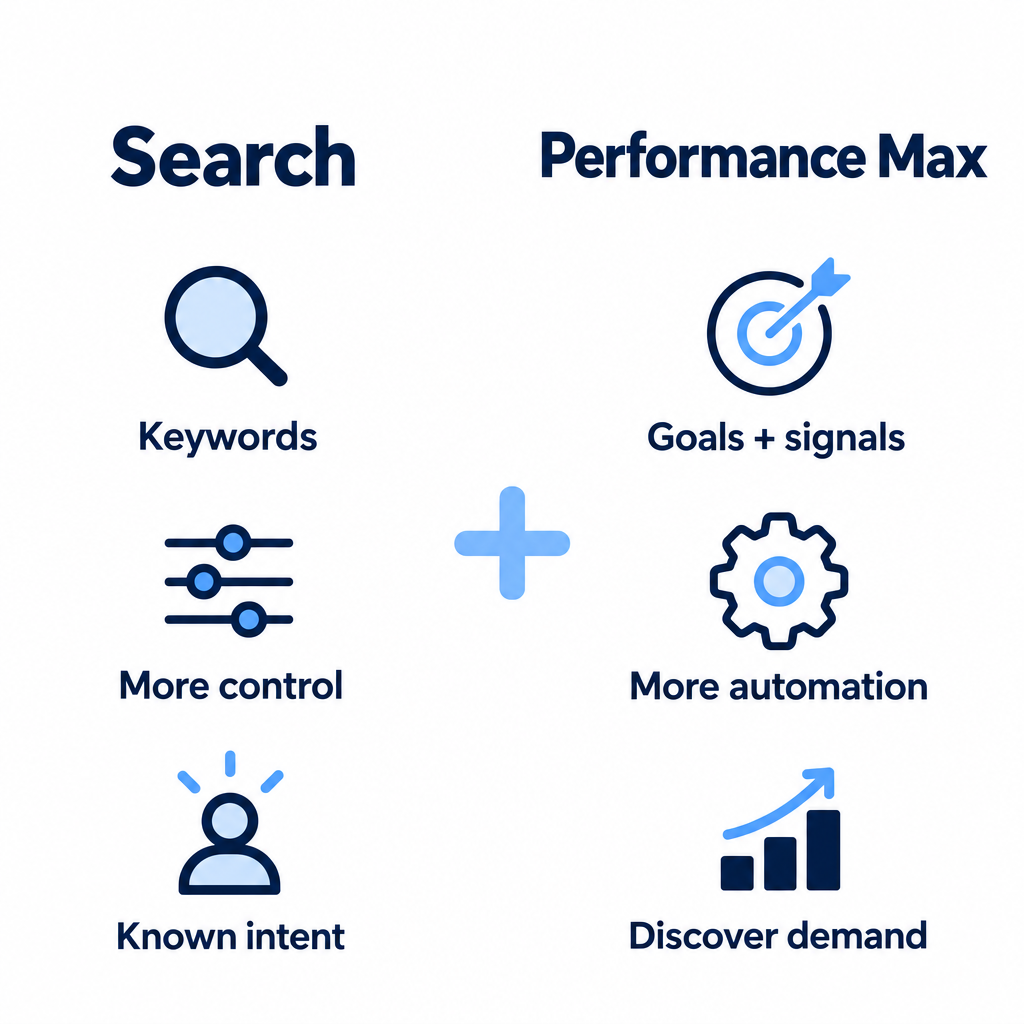
Search is still valuable because you can deliberately target people who are already expressing a specific need.
PMax is valuable because the nonprofit does not need to know every search phrase in advance.
Should Performance Max replace your Search campaigns?
Usually, no.
For many nonprofits, I would test Search + Performance Max rather than choosing only one.
Search can handle predictable intent such as:
- donate to [cause]
- volunteer near me
- [service] nonprofit
- [program] help
PMax can then help discover additional demand around your goals and audiences.
This gives you a better comparison than spend alone: Is PMax producing useful actions that Search was missing?
When should a nonprofit test Performance Max?
1. When Search is getting very few impressions
Some Ad Grants Search campaigns struggle to find enough eligible search volume, especially when the nonprofit is local, niche, or operating in a competitive category.
Jason King repeatedly recommends PMax as a test in low-impression accounts because it often finds traffic more easily than Search.
If this is your problem, also read Why Is My Google Ad Grant Getting Zero Impressions?.
2. When you have a specific conversion goal
Google specifically positions PMax for nonprofits with concrete goals such as online donations, volunteer signups, memberships, event registrations, calls, and service inquiries.
PMax depends heavily on the goals you give it. If your conversion setup is weak, the campaign can optimize toward the wrong behavior.
3. When the nonprofit serves several types of people
A nonprofit may have donors, volunteers, service users, families, advocates, event attendees, and community partners. It can be difficult to predict every keyword those groups might use.
PMax can use multiple audience signals, themes, assets, and landing pages to help Google explore that broader opportunity.
4. When you are a local nonprofit that wants visits
Jason King notes that Performance Max can place Ad Grant ads on Google Maps when the nonprofit has the appropriate Google Business Profile and location asset setup.
That can be useful for organizations such as museums, churches, animal shelters, charity shops, galleries, community centers, and local service organizations.
For nonprofits that depend on physical visits, Maps can create a type of local visibility that Search campaigns alone do not provide in the same way.
Conversion tracking comes before PMax
Before launching Performance Max, make sure conversion tracking is trustworthy.
Google Ad Grants requires active and accurate conversion tracking for applicable accounts. Good PMax goals can include completed donations, volunteer applications, registrations, inquiries, calls, memberships, and meaningful signups.
Weak goals include ordinary homepage views or other low-value events that do not represent real progress for the nonprofit.
The rule: PMax's automation is only as useful as the goal you give it.
If the campaign is told that almost every website visitor is a conversion, Google can become very good at generating the wrong type of traffic.
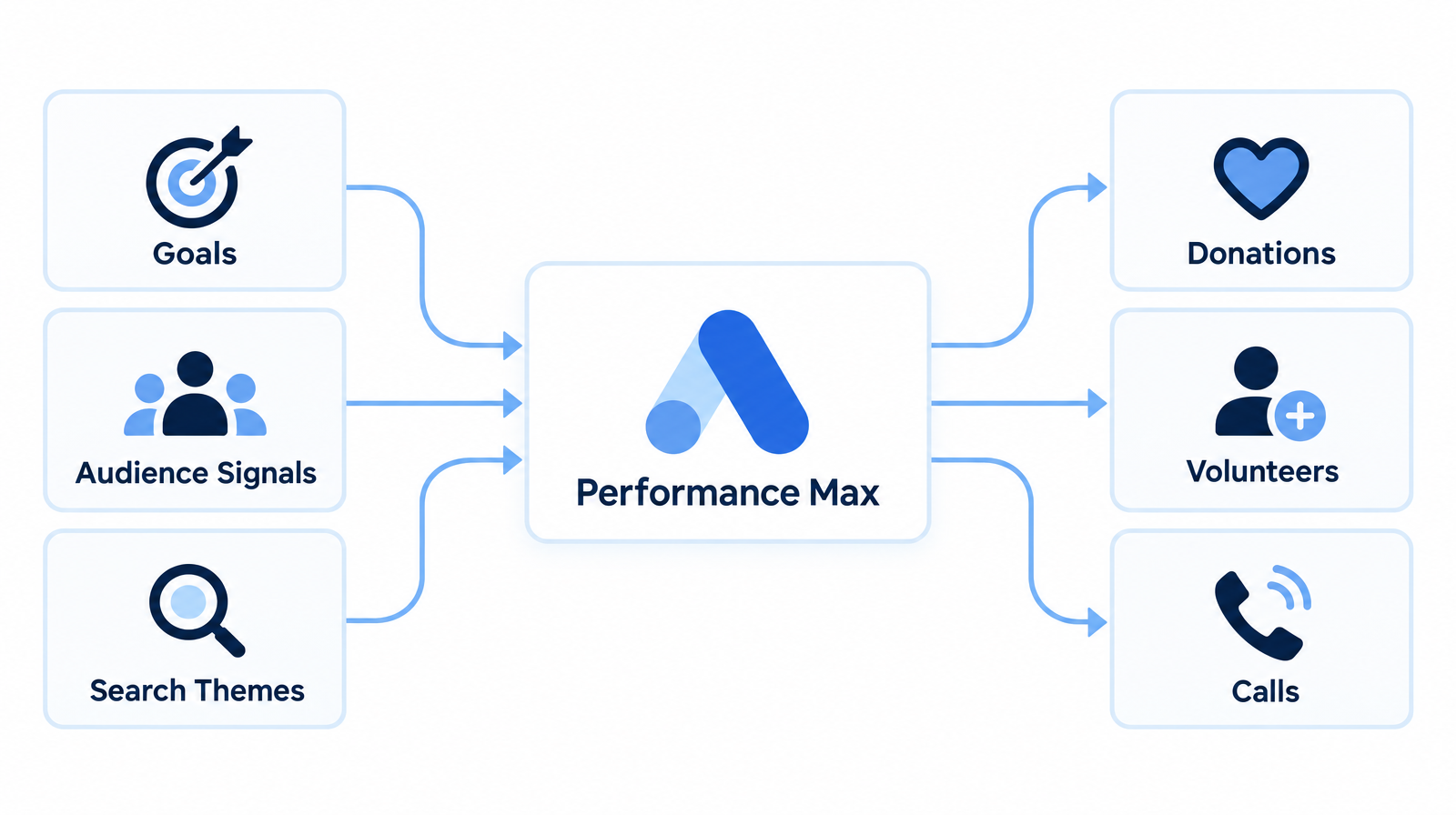
For the broader fundraising strategy around conversions, landing pages, and donor intent, see my Google Ad Grant guide for nonprofit donations.
Audience signals are important, but they are not strict targeting
Audience signals are suggestions to Google's AI, not hard restrictions.
Google says signals help accelerate learning by showing the system what kinds of people may be more likely to convert. Google can still serve outside those signals when it predicts another user has a strong likelihood of converting.
Useful audience signals for a nonprofit may include:
- interests connected to the mission
- people searching for closely related topics
- website visitors, where appropriate and consented
- supporter or donor lists, where permitted
- custom segments based on relevant search behavior
- audiences related to the services the nonprofit provides
Do not treat audience signals as a substitute for conversion tracking. Signals help Google know where to start. Conversions teach Google what success looks like.
Use search themes to give Google additional direction
Search themes can help tell PMax what types of searches are relevant to the nonprofit. Think of them as strategic hints rather than a traditional keyword list.
For example, an animal shelter might use themes around:
- adopt a dog
- animal shelter
- volunteer with animals
- donate to animal rescue
- pet fostering
The goal is to give Google meaningful context without trying to recreate an entire Search campaign inside PMax.
Build strong asset groups
Google's current Ad Grants setup guidance recommends giving PMax multiple assets so the system can test combinations.
That includes up to 15 headlines, 5 long headlines, 1 short description, and 4 long descriptions. Google also recommends at least two unique sitelinks that go to specific pages rather than sending everything to the homepage.
Useful sitelinks might include Donate, Volunteer, Programs, Events, Get Help, and About the Mission.
Do you need more than one asset group?
There is no special Ad Grants rule requiring multiple PMax asset groups.
Jason King notes that nonprofits may benefit from more than one when the organization has clearly different audiences or themes, such as donors, volunteers, and service users.
But avoid creating unnecessary complexity just for the sake of structure.
Should you enable final URL expansion?
It depends on the website and goal.
Final URL expansion can help PMax choose other relevant pages on the nonprofit's site instead of sending every user to one fixed landing page. That can be useful when the website has many high-quality pages around programs, services, events, education, or local resources.
It can be a bad fit when the campaign is supposed to drive one very specific action on one specific landing page.
Use final URL expansion when several pages could genuinely satisfy the searcher's intent. Keep it controlled when the conversion path needs to stay focused.
Performance Max can help spend more, but spend is not the goal
Jason King reports that PMax can often spend more easily than Search in an Ad Grant account. That is useful because many nonprofits struggle to use much of the available $10,000 monthly Grant budget.
But spending more does not automatically mean the campaign is better.
Jason also notes that PMax may produce higher CPC, lower CTR, and lower conversion rate than Search in some accounts.
The metric that matters is whether the campaign produces useful nonprofit outcomes.
A campaign that spends $8,000 and generates weak traffic is not automatically better than a Search campaign that spends $2,500 and generates high-quality volunteer applications or donations.
The $10,000 Grant is a ceiling, not a quota you have to consume.
What metrics should you use to judge PMax?
Start with the nonprofit's real goals:
- donations and donation value
- volunteer signups
- completed applications
- event registrations
- calls
- membership signups
- qualified inquiries
- cost per meaningful conversion
Then use clicks, impressions, CPC, and CTR as supporting delivery metrics.
Do not make CTR the main success metric for PMax. PMax behaves differently from Search, and practitioner guidance notes that its CTR can be lower, especially when Google Maps traffic is involved.
What about the 5% CTR rule?
Google's written Ad Grants policy has historically included an account-level 5% CTR requirement for applicable Search activity.
Jason King reports that this rule has not been actively enforced for several years, and his 2026 training states that Performance Max is exempt from the 5% CTR rule.
Because Google's written policy and current practitioner experience are not always framed the same way, I would not build your PMax strategy around trying to inflate CTR.
Focus on relevance, conversions, and mission outcomes.
PMax is especially interesting for local nonprofits
For a local nonprofit, Performance Max may be one of the most important recent Ad Grants changes because it can create Google Maps visibility.
Jason King specifically highlights local organizations such as museums, churches, animal shelters, galleries, and charity shops as strong candidates.
To use that opportunity, the nonprofit generally needs:
- an approved Google Business Profile
- the Business Profile connected appropriately in Google Ads
- a location asset
- a Performance Max campaign
For organizations that depend on physical visits, this can be more valuable than simply chasing additional website traffic.
Common Performance Max mistakes in Google Ad Grants
Optimizing for weak conversions
If the goal is too easy, Google's automation may chase low-quality activity.
Launching without useful audience signals
PMax can still run, but you are giving Google less information about where to begin.
Using one generic message for everyone
Donors, volunteers, and service users may need different messaging and landing pages.
Judging the campaign only by spend
The purpose of the Grant is impact, not using the entire budget at any cost.
Replacing Search before comparing results
In many accounts, PMax works best as an additional campaign rather than a complete replacement.
Sending everything to the homepage
Strong campaign goals deserve relevant landing pages and clear calls to action.
A practical PMax setup checklist
| Area | What to confirm |
|---|---|
| Conversion goals | Are they meaningful and accurately tracked? |
| Geography | Does it match the people the nonprofit can actually serve? |
| Audience signals | Have you given Google useful starting signals? |
| Search themes | Do they reflect real mission-related demand? |
| Assets | Do headlines, descriptions, and images support the goal? |
| Sitelinks | Do they send people to useful specific pages? |
| Landing pages | Do they match the action you want people to take? |
| Final URL expansion | Should Google choose among multiple relevant pages? |
| Maps | Could a local organization benefit from a Business Profile and location asset? |
| Measurement | Are you judging meaningful conversions, not just spend? |
When I would keep Search as the priority
I would still prioritize Search when the nonprofit has very clear, high-intent keywords, needs precise control over queries, relies on one focused landing page, or needs easy visibility into what people searched.
Search remains one of the strongest ways to capture explicit intent.
When I would prioritize a PMax test
I would test PMax sooner when Search has low impressions despite a sound setup, the mission has many possible search paths, the nonprofit serves multiple relevant audiences, conversion tracking is strong, the website has useful content, or the organization could benefit from Maps visibility.
My recommended structure for many nonprofits
Campaign 1: Search
Capture clear mission-related and high-intent searches.
Campaign 2: Performance Max
Give Google room to discover additional conversion opportunities using audience signals, search themes, assets, and relevant landing pages.
Then compare both campaigns based on meaningful actions, not just impressions or spend.
Methodology
I reviewed Google's current Google Ad Grants setup guide, conversion-tracking policy, budget and bidding guidance, and current Performance Max documentation.
Google's setup guide explicitly allows Ad Grants users to choose Performance Max or Search and recommends PMax when the organization has specific conversion goals. Google also recommends adding multiple creative assets, at least two unique sitelinks, and audience signals to help accelerate optimization.
I also reviewed Jason King's 2026 Google Ad Grants training and community guidance. Jason describes Performance Max as one of the biggest changes to the program in years, reports that it can often spend more easily than Search, highlights Google Maps as an important opportunity for local nonprofits, and recommends judging PMax by actual nonprofit outcomes rather than spend alone.
Jason's recommendations are practitioner guidance, not formal Google policy. Google's official Ad Grants documentation remains the authority for program requirements.
If you want help deciding whether Search, Performance Max, or both make sense for your nonprofit, I can review the account and campaign structure through my nonprofit Google Ad Grant services.