Direct answer
Choosing local keywords for a Twin Cities business starts with a simple question: what would a real customer search when they are ready to find, compare, or contact a business like yours?
The answer is usually not one keyword. It is a group of related searches built around your services, the problem being solved, the customer's location, and the stage of the buying process.
For a local business, I would rather build a smaller set of useful keyword themes around real customer intent than create a giant spreadsheet full of phrases that never influence a page, offer, or decision.
This guide expands on the keyword section in my Twin Cities local SEO and Google Business Profile guide. The goal here is to show how I would turn local keyword research into an actual website and content plan.
What is a local keyword?
A local keyword is a search phrase that suggests the person wants a product, service, or business connected to a specific area.
That location can be explicit:
- chiropractor Minneapolis
- furniture store Bloomington MN
- SEO company St. Paul
- roofing contractor Eagan
Or it can be implied:
- chiropractor near me
- furniture store open now
- best roofer nearby
Google can use the searcher's location and other context when deciding which results are useful. That is why a local search does not always need a city name typed into the query.
Google says Search considers factors including the words in the query, the relevance and usability of pages, and the searcher's location and settings. Google Business Profiles can also appear on Search and Maps when people search for a business category in a local area.
The practical takeaway is that local keyword research should account for both service intent and location intent.
Start with the services that actually make money
Do not begin by typing your city into a keyword tool and downloading everything it suggests.
Start with the business.
List the services or product categories you actually want more customers for.
For example, a Twin Cities home-service company might start with:
- furnace repair
- furnace installation
- air conditioning repair
- heat pump installation
- emergency HVAC service
A marketing company might start with:
- Google Ads management
- Facebook Ads management
- SEO
- landing page design
- web design
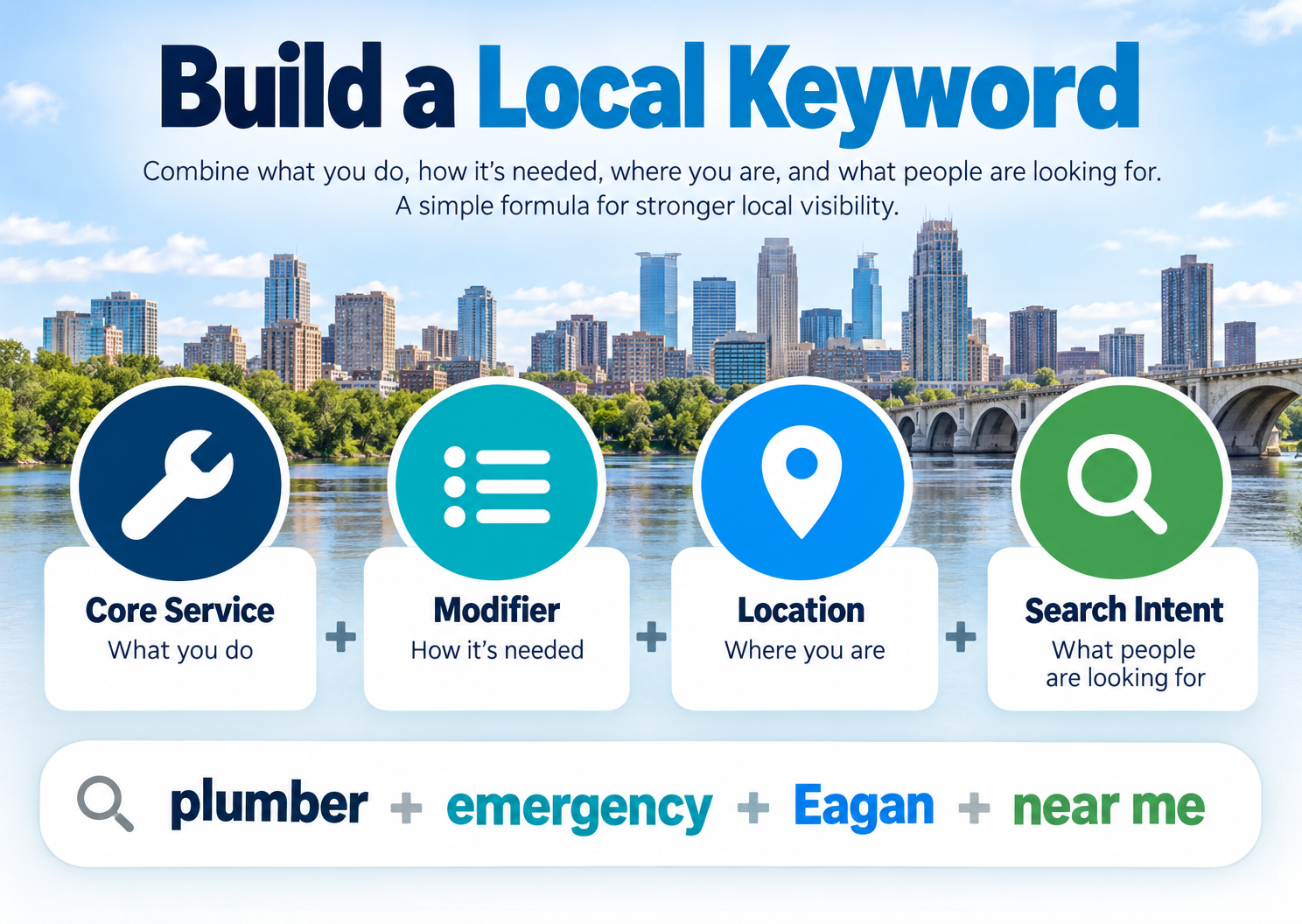
These are your core terms. BrightLocal's local keyword research framework uses the same basic idea: identify the core service, expand it with modifiers, add relevant locations, then organize the keywords by intent.
This step matters because your keyword plan should reflect business priorities. A service you rarely sell or do not want to grow should not automatically receive the same SEO attention as your highest-value offer.
Add the words customers use around the service
The next step is to expand the core term with modifiers that reveal what the customer wants.
For example, someone looking for a plumber might search:
- emergency plumber
- plumber near me
- same-day plumber
- water heater repair
- licensed plumber
- plumbing company
- plumber cost
Someone looking for Google Ads help might search:
- Google Ads management
- Google Ads agency
- PPC company
- Google Ads consultant
- Google Ads cost
- why Google Ads are not generating leads
These phrases do not all belong on the same page.
A person searching Google Ads management Minneapolis is likely evaluating a service provider.
A person searching how much does Google Ads cost in Minneapolis is researching pricing.
A person searching why are my Google Ads getting clicks but no leads has a troubleshooting problem.
Those are three different search intents, and they may deserve three different pages or articles.
That distinction is already part of the structure of my Google Ads for Minneapolis Businesses guide, where pricing, troubleshooting, tracking, and landing-page questions each support the broader topic.
Add only the locations that matter to the business
After defining the service and modifiers, add the geographic terms customers might realistically use.
For a Twin Cities business, that could include:
- Minneapolis
- St. Paul
- Bloomington
- Eagan
- Eden Prairie
- Maple Grove
- Burnsville
- Minnetonka
- Woodbury
- nearby suburbs the business actually serves
But this is where local keyword research can go wrong.
Do not assume that adding every Twin Cities suburb creates a useful SEO strategy.
The location should reflect one of three things:
- A real business location.
- A genuine service area.
- A meaningful market where customers regularly come from.
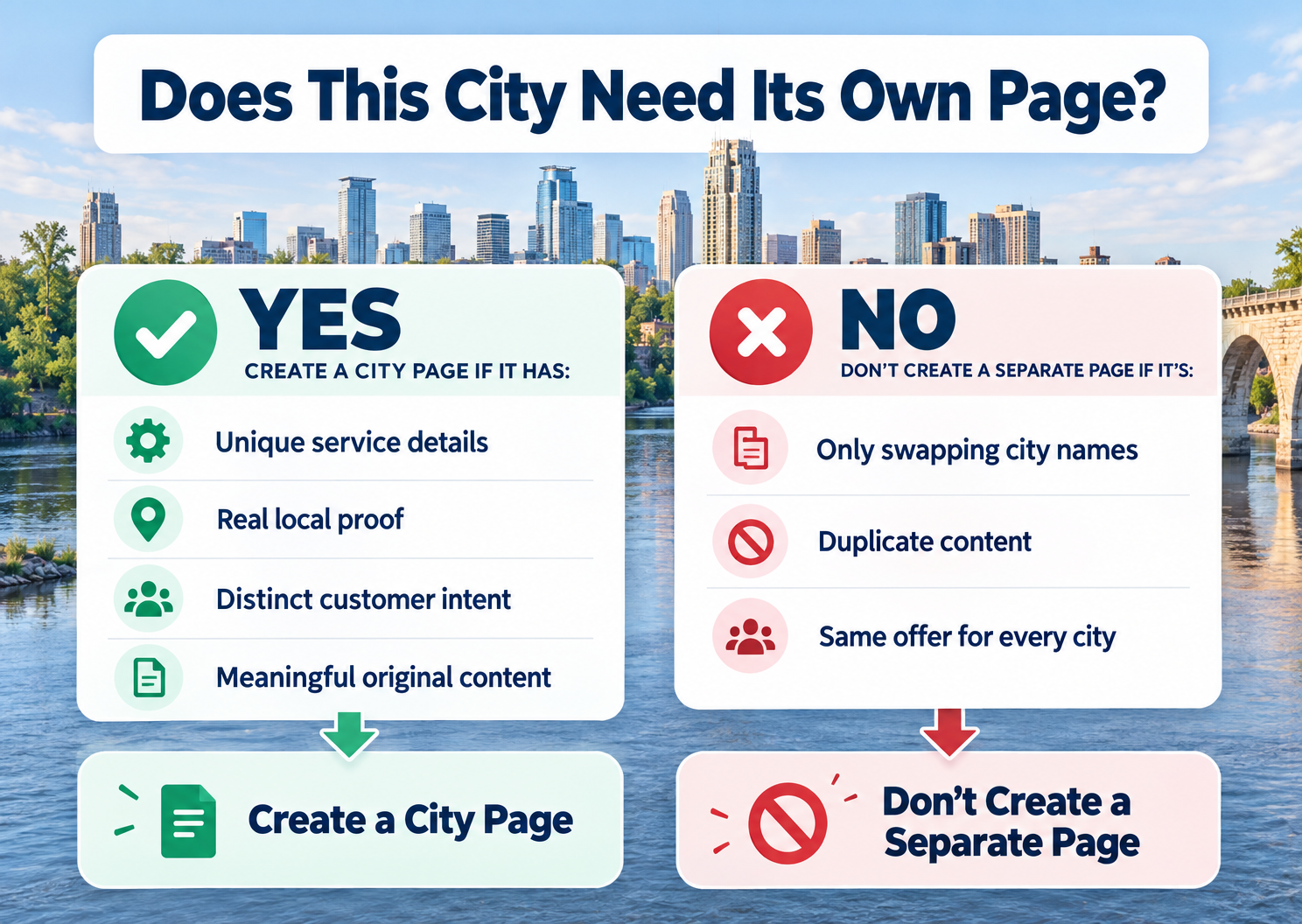
A business that serves Minneapolis, Bloomington, and Eagan may have a reason to research searches involving those locations. That does not mean it needs separate pages for all three.
The keyword research tells you what people search. The page strategy still has to answer whether a separate page would be useful and distinct enough to deserve its own URL.
Do you need a page for every city keyword?
Usually, no.
A common local SEO mistake is creating dozens of nearly identical pages such as:
- plumber Minneapolis
- plumber St. Paul
- plumber Bloomington
- plumber Eagan
- plumber Burnsville
Then the only meaningful difference between the pages is the city name.
That creates a poor experience for visitors and can move toward the kind of doorway-page behavior Google's spam policies warn about when substantially similar regional pages exist mainly to funnel users to the same destination.
I would create a separate location page when there is enough real information to make that page useful.
Examples include:
- a staffed physical location
- a genuinely different service area
- unique local projects or customer examples
- different hours, contact information, or availability
- meaningful local service details
- a location-specific offer or process
If none of those exist, one strong service page with clear service-area information may be better than ten weak city pages.
Group local keywords by search intent
Once you have a list of service and location phrases, organize them according to what the searcher is trying to accomplish.
I use four practical groups:
| Intent | Example search | Best content type |
|---|---|---|
| Hire or buy | roofing contractor Minneapolis | Service page |
| Compare | best roofing companies Minneapolis | Service page, comparison content, proof |
| Research | roof replacement cost Minneapolis | Guide or pricing article |
| Solve a problem | roof leaking after storm Minneapolis | Helpful article or service page |
This is more useful than treating every keyword as an isolated phrase.
Search intent helps answer the real SEO question: which page should satisfy this search?
If ten related keywords all describe the same customer need, one strong page may be able to serve them naturally.
If the keywords represent different problems or stages of the buying process, forcing them all onto one page can make the page unfocused.
Look at the actual search results before choosing a target
A keyword tool can show estimated search demand. Google shows you what kind of content is actually being rewarded for the query.
Search the keyword yourself and review the results.
Ask:
- Does Google show local businesses, directories, or informational articles?
- Is there a local map pack?
- Are the organic results service pages or blog posts?
- Are the top results targeting Minneapolis specifically or broader Minnesota terms?
- Does the search appear commercial, informational, or mixed?
The search results can reveal that the phrase you thought should be a service page is actually dominated by informational content, or that a broad keyword has strong local intent even without a city name.
This also helps avoid creating pages based only on search-volume estimates.
Use Google Search Console to find the language customers already use
For an existing website, Search Console can be one of the most useful local keyword sources because it shows the queries already producing impressions and clicks.
I would look for patterns such as:
- service terms that repeatedly generate impressions
- city or suburb names appearing with core services
- question-style searches
- pages receiving impressions for searches they only partially answer
- high-impression queries with weak click-through rates
For example, if a roofing page is receiving impressions for “storm damage roof repair Bloomington” but barely discusses storm damage, that can reveal a content gap.
Search Console does not tell you every search in the market, but it gives you direct evidence about how Google already connects your website with search queries.
Use customer language, not just marketing language
Businesses often describe their services differently from customers.
A company may call a service “residential exterior restoration,” while customers search “siding repair.”
An agency may call a service “paid media management,” while a business owner searches “Google Ads company.”
That is why I would gather keyword ideas from more than keyword tools.
Useful sources include:
- sales calls
- contact-form submissions
- CRM notes
- customer emails
- Google Search Console
- Google autocomplete and related searches
- competitor service pages
- reviews
- frequently asked questions
- industry terminology customers actually understand
The goal is not to copy every phrase customers use. It is to understand the language around the problem and choose terms that accurately describe the service.
Should you target “near me” keywords?
You should understand them, but you usually do not need to force “near me” repeatedly into website copy.
A person searching SEO company near me or chiropractor near me is signaling local intent. Google can use location information to decide which businesses and pages are relevant.
Your website should instead make the local relationship clear through accurate business information, service-area details, relevant page content, and a properly maintained Google Business Profile.
Writing sentences such as “If you need a chiropractor near me near you” does not make the page more useful.
Write for the customer. Let the site structure and business information establish the geography naturally.
How many local keywords should one page target?
I do not use a fixed number.
A page should have one clear primary topic and then naturally answer closely related searches around that topic.
For example, a Google Ads management page might naturally be relevant to:
- Google Ads management Minneapolis
- Google Ads company Minneapolis
- PPC management Minneapolis
- Google Ads agency Twin Cities
- paid search management Minnesota
Those phrases can represent the same core service intent.
I would not create five nearly identical pages just to assign one phrase to each URL.
Instead, build the strongest page for the customer need, then use supporting content for distinct questions such as pricing, troubleshooting, tracking, or comparisons.
What should you do with the keyword list after research?
The keyword list should turn into a page map.
For each important search theme, decide:
- Primary intent
- Target customer
- Service or problem
- Relevant location
- Existing page or new page
- Supporting article opportunities
- Internal links
- Conversion action
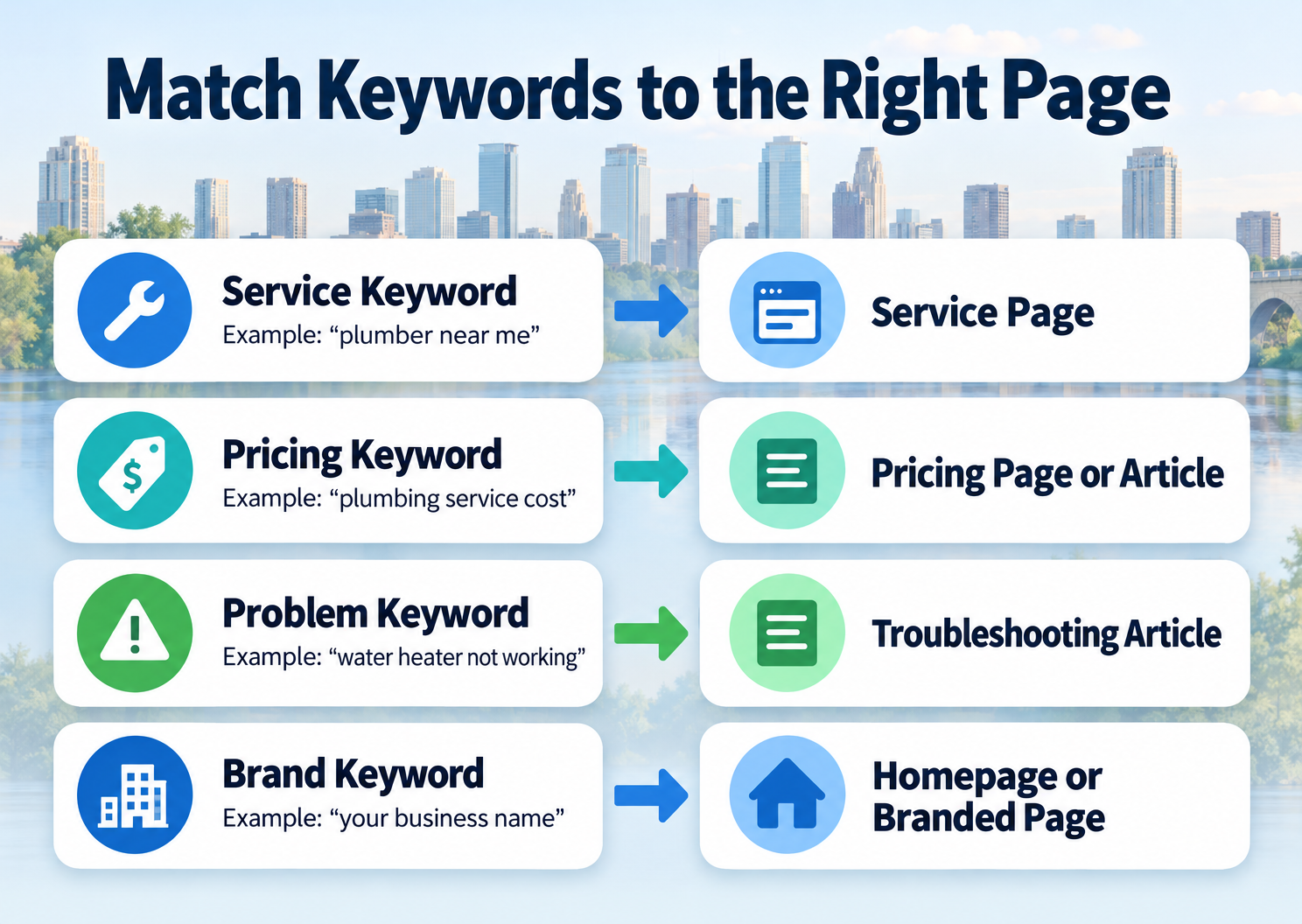
A simplified example might look like this:
| Keyword theme | Page |
|---|---|
| Google Ads management Minneapolis | Google Ads service page |
| Google Ads cost Minneapolis | Pricing article |
| Google Ads clicks no leads | Troubleshooting article |
| local SEO Twin Cities | Local SEO guide |
| Minneapolis landing page design | Landing page service or guide |
This is the point where keyword research becomes SEO strategy.
Without the page map, keyword research often ends as a spreadsheet nobody uses.
How should local keywords connect to your Google Business Profile?
Your Google Business Profile and website should describe the same real business.
Google says Business Profiles can appear when customers search for a category or business in a local area, and Google can use information from the business's official website as one source of Business Profile information.
That means the profile category, services, website, and page content should make the business's actual offering easy to understand.
This does not mean stuffing keywords into the business name or inventing services to rank for more searches.
Use the real business name, accurate categories, genuine services, and useful website pages.
My Twin Cities Google Business Profile and local SEO guide covers the profile side in more detail. If the profile is visible but still not producing enough calls, use my Google Business Profile not getting calls troubleshooting guide to separate visibility, trust, phone routing, and lead-quality problems.
How often should you update local keyword research?
Keyword research should not be a one-time project.
Customer language changes. Services change. Competitors change. New pages begin earning impressions for unexpected queries.
I would revisit priority keyword themes when:
- launching a new service
- expanding into a meaningful new service area
- redesigning the website
- seeing new Search Console query patterns
- rankings or lead volume change significantly
- creating a new content cluster
BrightLocal also recommends treating local keyword research as an ongoing process because search behavior and platforms continue to change.
A simple Twin Cities local keyword research process
If I were building the plan from scratch, I would use this sequence:
- List the services and products the business actually wants to grow.
- Identify the plain-language terms customers use for each one.
- Add commercial, problem, comparison, and pricing modifiers.
- Add only the cities and suburbs the business genuinely serves.
- Review Google results for each priority search theme.
- Check Search Console for existing impressions and customer language.
- Group related keywords by search intent.
- Map each theme to the most appropriate existing or new page.
- Avoid duplicate city pages that do not provide unique value.
- Connect the final pages through useful internal links.
- Measure rankings, traffic, inquiries, and qualified leads separately.
The result should be a website structure built around customer needs, not a collection of pages created only because a keyword tool produced a phrase.
What I would prioritize for a Twin Cities business
Start with the searches closest to revenue.
Identify the service terms customers use when they are ready to hire, then match those terms to strong service pages. After that, build supporting content around pricing, comparisons, troubleshooting, and common questions.
Use Minneapolis, St. Paul, and suburb names where they accurately reflect the business and customer search behavior. Do not manufacture location pages just to create more URLs.
Then connect the keyword strategy to the Google Business Profile, internal linking, and conversion path so visibility has somewhere useful to go.
If you need help building that system, see my SEO and AI search optimization services. For the broader local visibility framework, use my Twin Cities local SEO and Google Business Profile guide.
If paid search is part of the plan too, my Google Ads for Minneapolis Businesses guide explains how paid search fits alongside local SEO.
Book a strategy call if you want me to review your services, search intent, and current site structure and turn them into a practical keyword and page plan.