Direct answer
Google Ads and Facebook Ads can both generate leads and sales for Twin Cities businesses, but they usually work best at different stages of the customer journey.
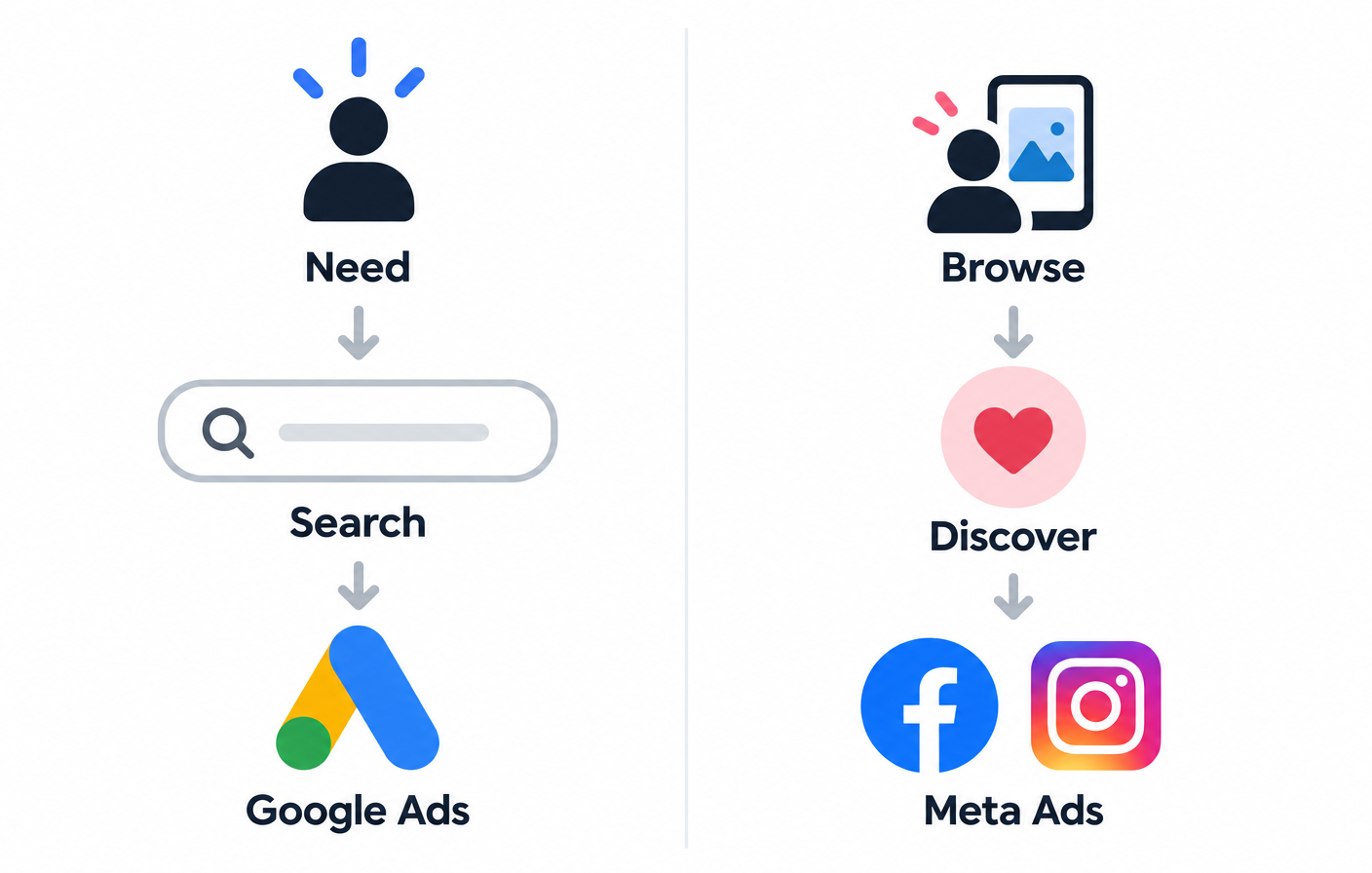
The simplest way I explain it is this: Google Ads is strongest when people are already looking for what you sell. Facebook and Instagram Ads are strongest when you need to create demand, interrupt attention, or stay in front of people before they search.
That does not mean every local service business should automatically choose Google, or every retailer should automatically choose Meta. The right platform depends on how people buy, how urgent the need is, how visual the offer is, how much demand already exists, and what happens after the click.
If you are building a broader paid advertising plan, start with my Google Ads guide for Minneapolis businesses. This article focuses specifically on choosing between Google Ads and Facebook or Instagram Ads.
Quick answer: which one should a Twin Cities business use?
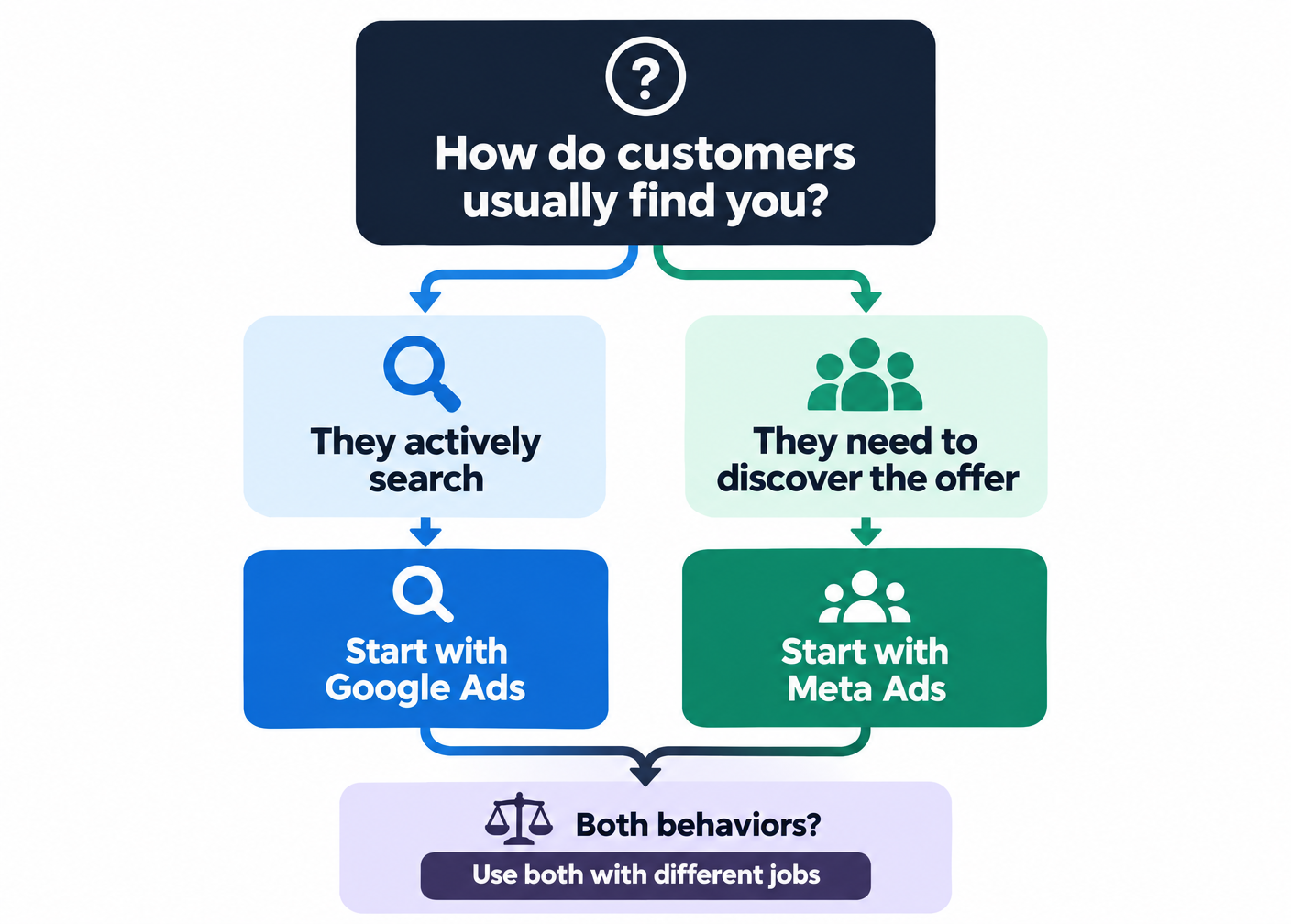
Use Google Ads first when customers commonly search for the service because they already know they need it.
Examples can include:
- plumbers
- chiropractors
- attorneys
- roofers
- financial services
- mortgage professionals
- urgent or high-intent local services
Use Facebook and Instagram Ads first when the business benefits from visual discovery, a strong offer, repeated exposure, or demand creation.
Examples can include:
- furniture stores
- gyms
- med spas
- restaurants
- events
- ecommerce
- real estate lead generation
- promotional retail campaigns
Use both when one platform can capture demand and the other can create or reinforce it.
For many Twin Cities businesses, that combination is stronger than treating the platforms as competitors.
Google Ads captures existing demand
Google Search campaigns are designed to reach people while they are actively searching for products or services. That is the main reason Google tends to be a natural first choice for businesses where the customer already knows what problem needs to be solved.
Someone searching for “emergency plumber Minneapolis,” “chiropractor near me,” or “1031 exchange advisor” is already expressing intent. The advertising job is to show up for the right search, make the offer relevant, and give that person a clear next step.
That is also why keyword selection, search-term quality, conversion tracking, and landing-page relevance matter so much. Google can generate strong intent, but poor targeting can still turn expensive clicks into weak leads.
Google also now gives advertisers more ways to expand beyond traditional Search. Performance Max can reach users across Search, YouTube, Display, Discover, Gmail, and Maps, while Demand Gen is designed more around visual discovery and earlier-stage engagement across Google's broader surfaces.
For a Twin Cities service business with strong local search demand, I would usually evaluate Search first before assuming the account needs every campaign type available.
If Google is the likely fit, see how I structure Google Ads management.
Facebook and Instagram Ads create and shape demand
Meta Ads work differently because people are usually not opening Facebook or Instagram to search for a local business. They are browsing content.
That means the ad has to earn attention.
The offer, image or video, headline, audience, and timing all play a larger role in creating interest before the prospect was actively looking.
This can be especially effective when the business has something visually compelling or easy to understand quickly. A furniture sale, home listing, before-and-after service, event, limited-time offer, or product demonstration can make sense in a feed because the creative itself introduces the opportunity.
Meta also gives businesses multiple placements across Facebook and Instagram, including feeds, Stories, and Reels. Meta recommends creative that is built for those placements, particularly vertical creative for Reels.
The downside is that a low-cost Meta lead is not automatically a good lead. A campaign can generate cheap form submissions while producing weak buying intent. That is why qualification, CRM follow-up, and measuring downstream outcomes matter.
If Meta is the better fit, see my Facebook and Instagram Ads management service.
The biggest difference is intent
Here is the distinction I would use before looking at CPCs, CPMs, or platform benchmarks:
| Question | Google Ads | Facebook & Instagram Ads |
|---|---|---|
| Is the customer actively searching? | Often yes | Usually no |
| Main strength | Capture demand | Create or shape demand |
| Creative importance | Important | Extremely important |
| Search keywords | Core input for Search | Not the main targeting model |
| Visual storytelling | Useful | Often central |
| Best for urgent needs | Often strong | Usually less direct |
| Best for discovery | Possible across Google surfaces | Often strong |
| Retargeting | Available | Available |
| Lead quality risk | Irrelevant or expensive clicks | Cheap but weak leads |
Neither platform wins every category.
The useful question is: What is the customer doing immediately before they become a realistic prospect?
If they search, Google has an advantage.
If they need to see, discover, or be reminded, Meta can have an advantage.
Which is better for a Minneapolis or Twin Cities service business?
For many service businesses, I would test Google first when there is clear local search demand.
A person searching for a service often has a shorter path between interest and action. They may already be comparing providers, prices, reviews, or availability.
But there are exceptions.
A service can perform well on Meta when the offer is easy to understand visually, the audience is broad enough, and the buying decision can be initiated before someone searches. Promotions, consultations, transformations, free assessments, and educational offers can all fit that model.
The service area matters too. A business serving Minneapolis, St. Paul, Bloomington, Eagan, or the broader Twin Cities metro should not automatically target the entire metro just because the platform allows it. The campaign geography should reflect where profitable customers actually come from and how far people are willing to travel.
Which is better for local retail?
Meta can be particularly useful for retail because products, sales, events, and store experiences are visual.
Google still matters because people search for products, stores, brands, and “near me” intent. Shopping campaigns, Performance Max, local inventory, and branded or category searches can all capture demand that already exists.
For retail, I often think about the two platforms as complementary:
- Meta introduces the sale, product, or reason to visit.
- Google captures people who later search for the product, store, or category.
- Retargeting keeps the business visible to people who engaged but did not buy immediately.
That is much closer to how people actually shop than forcing one platform to do every job.
Which is better for real estate, mortgage, and financial lead generation?
These categories require more nuance.
Google can be strong when the prospect is actively searching for a specific financial product, advisor, mortgage service, or investment solution.
Meta can be strong when the strategy is built around an audience, life stage, valuable offer, property type, educational angle, or longer nurture cycle.
The biggest mistake is judging these campaigns only by raw lead cost.
A $20 lead that never answers the phone is not necessarily better than a $100 lead that becomes a qualified appointment. In higher-value industries, the measurement system should connect the advertising platform to lead quality, booked calls, sales conversations, and closed business whenever possible.
What if Facebook leads are cheaper than Google leads?
That does not automatically make Facebook the better platform.
Lead cost is only one stage of the funnel.
I would compare:
- cost per lead
- contact rate
- qualified lead rate
- appointment rate
- show rate
- sales rate
- revenue or estimated value per lead
This is one reason I do not like optimizing campaigns around vanity metrics.
Google can look expensive at the top of the funnel while producing stronger intent. Meta can look inexpensive while requiring more qualification and nurture. The reverse can also happen depending on the offer and market.
The correct comparison is the cost to create a useful business outcome, not just the cheapest form submission.
When should you run both Google Ads and Meta Ads?
Running both makes sense when each platform has a different job.
A simple local strategy could look like this:
- Google Search captures active demand.
- Meta builds awareness and promotes offers.
- Both platforms retarget engaged visitors where appropriate.
- The landing page turns traffic into an inquiry or sale.
- CRM follow-up keeps leads from going cold.
- Qualified outcomes are fed back into campaign decisions.
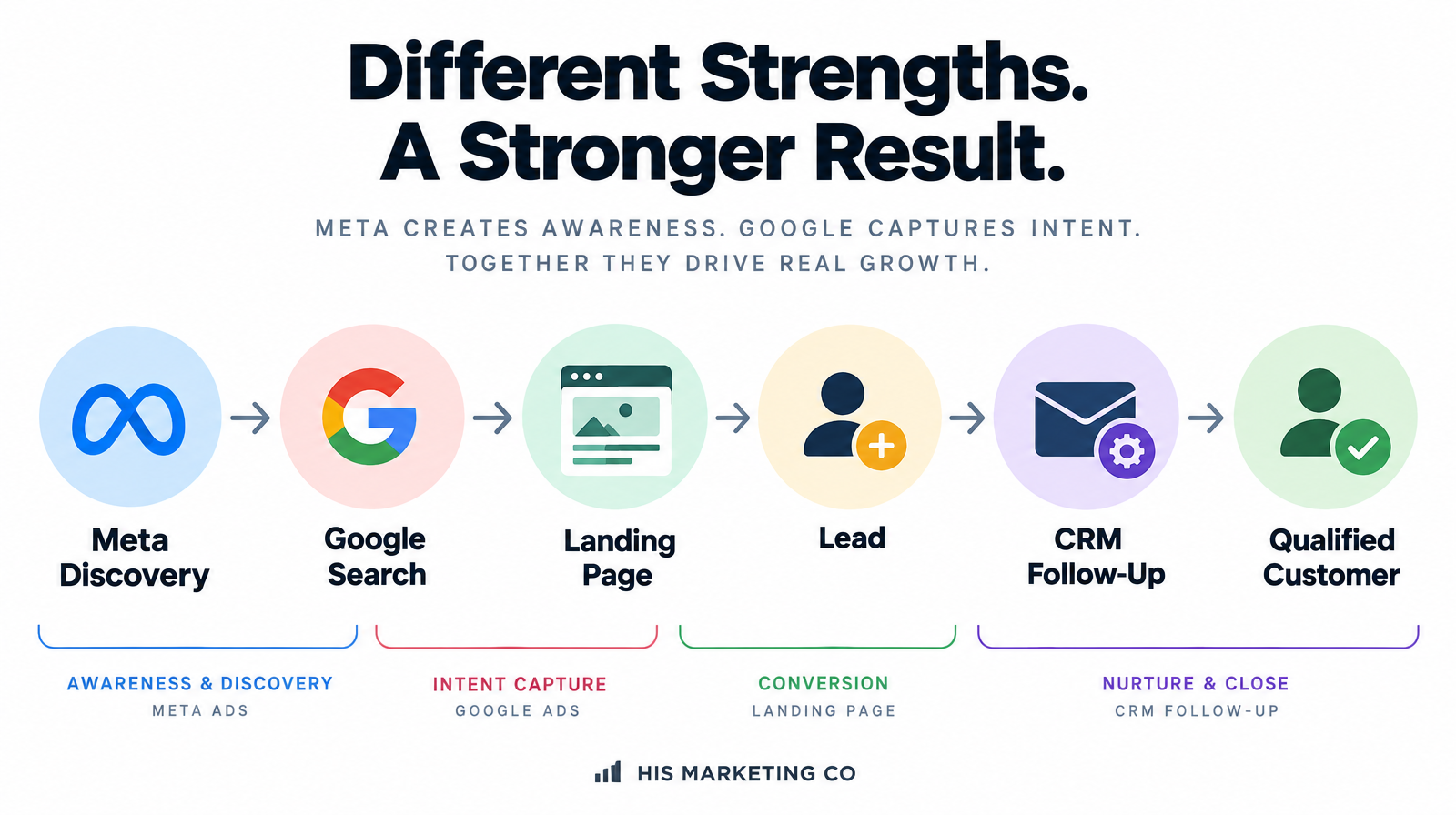
This is usually more useful than asking which platform is universally better.
The strongest system is the one where the ad channel matches customer behavior and the rest of the funnel supports the click.
Do I need a separate landing page for each platform?
Not always, but the page should match the intent and promise of the campaign.
Google traffic often arrives with a more specific search intent, so the page should quickly confirm that the visitor found the exact service or solution they were looking for.
Meta traffic may need more context because the user did not necessarily begin with a search. The page may need to explain the problem, offer, proof, and next step more clearly.
In both cases, sending every campaign to a generic homepage can make it harder for the visitor to understand what to do next.
If the destination is the weak point, review my landing page design service.
What should I choose if my budget is limited?
If you cannot fund both platforms properly, I would rather start with the one that best matches current buying behavior than spread the budget too thin.
Ask these questions:
- Are people already searching for what I sell?
- Is the need urgent or high intent?
- Does the offer require visual demonstration?
- Can I create strong photos or short-form video consistently?
- Do I have a compelling offer for people who were not already shopping?
- How quickly can my team follow up with a new lead?
- Can I track qualified outcomes, not just clicks and forms?
If strong search demand already exists, Google is often the cleaner first test.
If demand needs to be created and the offer is visually compelling, Meta may be the better first test.
Google Ads vs Facebook Ads: my recommendation for Twin Cities businesses
I would not choose a platform based on which one another business says is cheaper.
I would choose based on how your customers buy.
Start with Google Ads when you need to capture people already searching. Start with Facebook and Instagram when you need to create demand, show the offer visually, or reach people before they search. Use both when the customer journey benefits from both discovery and intent.
Then judge the result by qualified leads, sales, appointments, store visits, or another real business outcome.
That is the same framework I use across my broader Google Ads guide for Minneapolis businesses: match the channel to intent, track what matters, and make sure the landing page and follow-up system are strong enough to turn traffic into revenue.
If you want help deciding where your budget should go, you can book a strategy call and I can look at your business, market, offer, and customer journey before recommending a platform.