
Direct answer
A high-converting landing page turns paid advertising traffic into meaningful business opportunities by matching the ad's promise, answering the visitor's questions and making the next step easy. Google Search visitors often need a direct solution, while Facebook and Instagram visitors may need more context before taking action. Both need a reliable follow-up and measurement system to turn inquiries into customers.
When I build advertising campaigns, I do not treat the landing page as a separate web design project. I look at the entire journey from the first ad impression to the eventual sale. A campaign can produce excellent click-through rates and still lose money if the page or follow-up process fails.
What makes a landing page high-converting?
A high-converting landing page is a focused destination designed to persuade relevant visitors to complete a specific action, such as requesting an estimate, scheduling a consultation, calling a business, making a purchase or donating.
A homepage typically serves multiple audiences and introduces an entire business. A campaign landing page has a narrower job: deliver on the promise that earned the click and help a suitable visitor decide what to do next.
HubSpot's historical landing page benchmark research reported 55% more leads when companies increased their landing page count from 10 to 15. This is a reported association, not evidence that creating five additional pages will automatically increase any business's leads by that amount.
The lesson is to create relevant destinations for meaningfully different offers and audiences, rather than sending every visitor to one generic page. A small local business might only need a few well-designed pages.
Why your ads fail without the right landing page
An ad earns attention by making a promise. The destination needs to fulfill that promise.
If a Google ad promotes furnace repair in Minneapolis but the visitor arrives at a homepage covering plumbing, electrical work and general maintenance, the visitor must locate the relevant information themselves. That additional effort can cost you an otherwise valuable inquiry.
The same problem occurs on Meta when an ad offers a particular promotion but its destination does not explain the offer or how to claim it.
I review these connections as part of my Google Ads management work, rather than assuming the advertising account is the only place to improve performance.
The cost of sending traffic to your homepage
A homepage can work when it matches the campaign's offer and provides a clear next step. The problem is not the URL itself. It is the mismatch between the visitor's expectations and what the destination delivers.
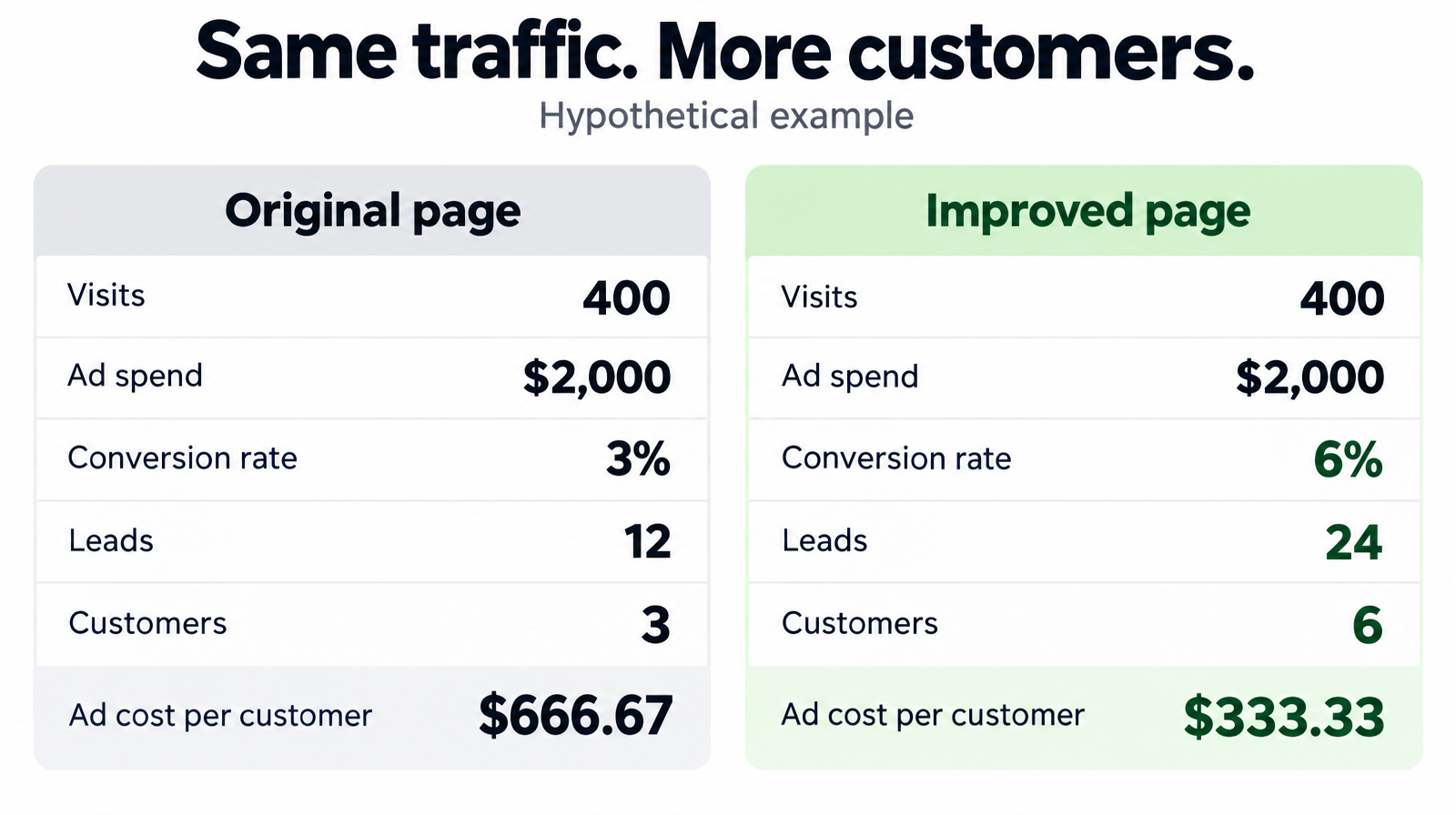
Consider this hypothetical example with the same $2,000 in advertising spend and 400 paid visits.
| Monthly result | Original page | Improved page |
|---|---|---|
| Paid visits | 400 | 400 |
| Visit-to-lead conversion rate | 3% | 6% |
| Leads | 12 | 24 |
| Advertising cost per lead | $166.67 | $83.33 |
| New customers, assuming a 25% lead-to-sale rate | 3 | 6 |
| Advertising cost per customer | $666.67 | $333.33 |
These are illustrative calculations, not client results or promised improvements. They assume traffic quality and lead-to-sale rates remain constant. In practice, those rates can change when you change a page.
The point is that improving conversion efficiency can increase the value of your existing advertising budget without necessarily buying additional traffic.
How ad-to-page alignment affects Quality Score
Google evaluates the usefulness and relevance of the landing page experience alongside other ad quality considerations. A destination that answers the searcher's needs is a better starting point than one that forces visitors to hunt for the advertised service.
Google's Quality Score guidance describes the reported score as a diagnostic tool, not an input directly used in the auction. Real-time assessments of ad quality can affect auction performance, but a higher reported score does not guarantee lower CPCs or better placement.
I use landing page experience diagnostics to identify possible problems, then measure whether improvements produce more qualified leads and profitable customers.
Core elements every high-converting landing page needs
The most useful landing pages combine a relevant offer, a clear decision path, credible proof and a usable experience. Visual design supports those objectives rather than replacing them.
A clear and compelling headline
The headline should quickly confirm that the visitor has arrived at the right destination. It should identify the offer, explain its relevance and avoid promises the business cannot fulfill.
For example, a search ad for kitchen remodeling estimates could lead to a page headed “Kitchen Remodeling in Minneapolis” with a short explanation of the services offered and a request-an-estimate button.
A Meta ad promoting a remodeling consultation might benefit from a headline that introduces the benefit of the consultation and explains what the homeowner will receive.
Both headlines should preserve the ad's promise, even when their emphasis differs.
One focused call to action
Choose one primary business outcome. A quote request, consultation booking or purchase should not have to compete with unrelated newsletters, downloads and service offers.
This does not mean the page can only have one button. Repeating the same action at useful points can help visitors proceed when they are ready. A phone number and form can also support the same inquiry goal, particularly for urgent services.
Ask for the information needed to respond and qualify the lead. Additional questions should serve a purpose, not merely make the form look comprehensive.
Trust signals that reduce hesitation
Visitors need a reason to believe the offer is legitimate and appropriate for them. Use genuine testimonials, relevant credentials, documented work examples, transparent terms and accurate business information.
Place proof where it answers a question the visitor is likely to have. A review about a comparable project may be more persuasive than a long carousel of unrelated testimonials.
My real client results provide examples of how advertising performance can be evaluated in a broader business context. Never invent reviews, results or credentials to fill gaps in a page.
Mobile-first design and fast load speed
Test the page on real mobile devices, not only on a desktop preview. The visitor should be able to read the offer, use the form, tap a phone link and complete the conversion without unnecessary difficulty.
Compress large images, avoid heavy scripts that delay interaction, and check whether sticky buttons or popups obstruct the form. Google's Web Vitals guidance identifies loading performance, interaction responsiveness and visual stability as important dimensions of web experience.
Do not assume every campaign has the same device distribution. Check your own analytics and test desktop and mobile experiences. A faster page is useful, but a performance score alone does not guarantee conversions.
How landing pages work differently for Google Ads vs. Meta Ads
The difference is not simply which platform sends the traffic. It is what the visitor knows and expects before arriving.
| Landing page decision | Google Search | Facebook and Instagram discovery ads |
|---|---|---|
| Visitor's starting point | Actively searching for a solution | Discovering an offer while browsing |
| First screen | Confirm the requested service and next step | Continue the ad's creative and explain the offer |
| Main supporting content | Service scope, availability, proof and objections | Benefits, context, demonstrations and proof |
| Typical action | Call, estimate or consultation | Inquiry, offer claim or consultation |
| Follow-up priority | Respond to the immediate need | Establish fit and nurture interest when necessary |
These are starting principles, not fixed templates. Branded search traffic, Meta retargeting and other Google campaign types can have different levels of awareness and intent.
Google Ads landing pages: capturing high-intent searchers
When someone searches for a specific service, lead with the answer. Confirm the service, geographic availability and offer immediately, then make the contact path easy.
For example, a Minneapolis homeowner searching for furnace repair may want to know whether the company serves their neighborhood, handles their problem and can provide a realistic next step. An extended brand story before those answers may create unnecessary friction.
The page should still contain enough information for a visitor to assess fit. Direct does not mean incomplete.
My guide to Google Ads for Minneapolis businesses explains how this page fits within keyword selection, campaign structure and conversion measurement.
Meta Ads landing pages: warming up cold audiences
A visitor arriving from a Facebook or Instagram discovery ad may not have been planning to purchase anything before seeing the offer. The page often needs to carry the creative concept forward, explain the value and establish credibility before asking for a decision.
For instance, in real estate and mortgage campaigns, I have found that an offer built around finding homes can attract more initial interest than an offer centered entirely on the mortgage process. The next stage needs to establish whether that interest represents a realistic buying opportunity.
Meta also supports native lead forms, so a website landing page is not always the only sensible destination. I compare the quality of leads and eventual customers from each approach rather than assuming the shortest form always wins. Housing and lending offers must comply with applicable advertising and consumer protection requirements.
See my Facebook and Instagram ads management service for the wider campaign strategy.
The role of follow-up systems after the landing page converts
A submission is a lead, not necessarily a customer. The next stage determines whether the business can turn that interest into a useful conversation and eventual sale.
I prefer to design the follow-up process before launching traffic so that the page, CRM and measurement system work together.
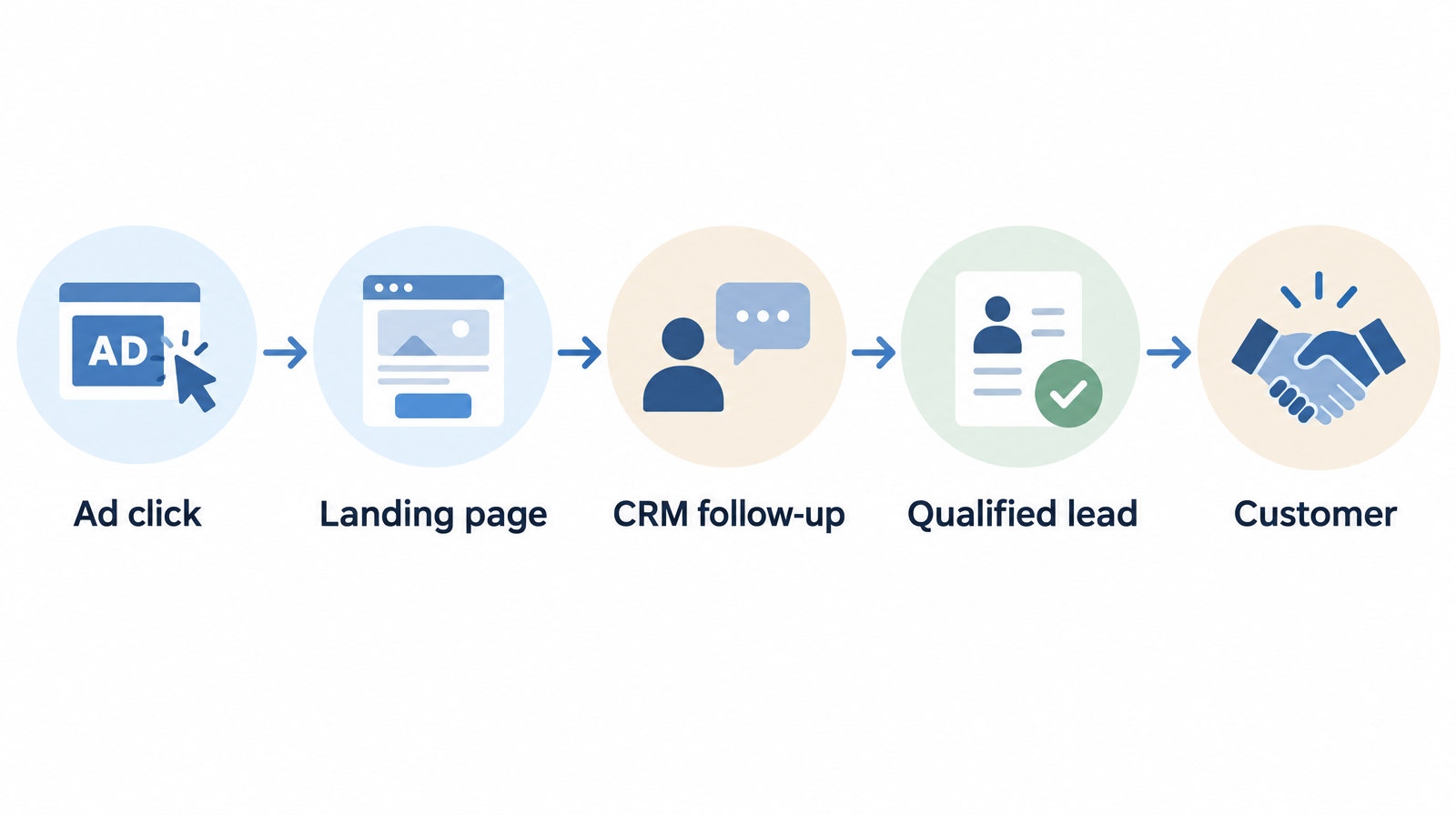
A practical lead journey looks like this:
- A relevant ad brings a visitor to the offer.
- The visitor submits a form or initiates a call.
- The CRM records the inquiry and its source where available.
- The business acknowledges the inquiry and follows up promptly.
- A team member or suitable qualification process establishes fit.
- Qualified prospects book appointments, receive estimates or progress toward a sale.
- The business records the outcome and uses reliable data to improve campaigns.
Automated email and SMS can help prevent missed follow-ups, provided the business has appropriate consent, honors opt-outs and complies with applicable requirements. Automation supports timely contact; it does not guarantee a sale or replace necessary human conversations.
My Google Ads lead tracking guide explains how to distinguish clicks, completed forms, genuine inquiries and qualified leads. Where supported, verified downstream outcomes can inform ad optimization.
How to measure whether a landing page produces real revenue
Measure more than the percentage of visitors who complete a form.
- Landing page conversion rate: completed target actions divided by eligible visits, using consistent definitions.
- Cost per lead: attributable advertising spend divided by leads.
- Qualified lead rate: qualified leads divided by total leads.
- Lead-to-customer rate: new customers divided by leads.
- Advertising cost per customer: advertising spend divided by acquired customers.
Include other attributable marketing and sales expenses when calculating fully loaded customer acquisition cost. Compare acquisition costs with the gross profit and capacity of the business, rather than treating revenue alone as proof of profitability.
A page that doubles form submissions but attracts unsuitable prospects may create more work without improving results. I would evaluate the entire funnel and account for the normal sales cycle before deciding which page to scale.
What does a high-converting landing page look like for Minneapolis businesses?
A Minneapolis business should make its offer locally relevant through accurate service areas, genuine local work examples and information that helps residents or business owners decide whether the provider meets their needs.
For example, a contractor may need to explain whether they serve Minneapolis, St. Paul, Edina or the broader Twin Cities metro. A local professional service may need to clarify whether consultations take place in person or remotely.
Local references should be useful and truthful, not just city names inserted throughout generic copy. I would not create a separate page for every suburb unless each page serves a distinct, meaningful purpose.
For a detailed breakdown of the actual page elements, see my landing page checklist for Minneapolis.
What about nonprofit landing pages?
The same principles apply, but the conversion goal is different. A nonprofit may want donations, volunteer registrations, event signups or applications for services.
A donation page should communicate the mission, establish credibility, explain the intended use of funds accurately and provide a trustworthy donation process. A volunteer recruitment page should explain the commitment and registration steps.
For organizations using Google Ad Grants, meaningful conversion tracking and program compliance also matter. See my Google Ad Grant guide for nonprofits for the campaign context.
How His Marketing Co builds landing pages that drive results
I build landing pages as part of a complete advertising system. I start by understanding the offer, the customer journey and the economics of acquiring a customer. Then I connect the page to the ad strategy, conversion tracking and follow-up process.
You work directly with me. There are no account managers between your business and the person making campaign and landing page decisions.
I am based in Minnesota and work with businesses nationwide. My focus is on testing the changes that can improve qualified opportunities and sales, not just making the page look better or increasing vanity metrics.
If your campaigns are generating traffic but not useful inquiries, explore my landing page design services. You can also book a strategy call to review your existing ads, page and follow-up process before deciding what needs to change.
Sources and methodology
I reviewed HubSpot's historical landing page benchmark and Google's guidance on Quality Score, ad quality and Web Vitals on November 25, 2026. The advertising economics table is a hypothetical illustration, not measured client performance. The channel-specific recommendations reflect practical campaign design principles and should be tested against each business's actual results.