
Direct answer
Google Search Ads are usually the better starting point when local customers are already searching for your service. Meta Ads are often the better starting point when a compelling offer can create demand on Facebook or Instagram. But the platform that deserves more of your budget is the one that generates profitable customers, not necessarily the most clicks or cheapest leads.
When I build paid advertising strategies for local businesses, I look at three things: existing demand, the economics of acquiring a customer, and the business's ability to turn inquiries into sales.
If you are specifically deciding which channel fits a Minneapolis-area business, my guide to Google Ads vs. Facebook Ads in the Twin Cities covers that decision in more detail. Here, I want to focus on where the money should go and how to know when to move it.
Why local businesses need to choose their ad platform wisely
A small advertising budget can disappear quickly when it is divided between too many campaigns, audiences and offers. Running both Google and Meta is not automatically a more complete strategy.
Before choosing a platform, establish what a new customer is worth in gross profit, how many inquiries become customers, and how much capacity you have to serve additional business. A campaign that fills your calendar with unprofitable jobs is not a successful campaign.
How Google Ads work for local businesses
Google Search captures existing demand. Someone searching for an emergency plumber, a roof replacement estimate or a Minneapolis marketing agency is already expressing a need. Your job is to match that need with a relevant offer and an easy next step.
Search ads and local intent
A keyword that includes a service and location can be more useful than a broad, high-volume keyword. For example, a plumbing company may value searches for water heater installation in its actual service area more than general searches about water heaters.
Start with commercially relevant searches, review the actual search terms that trigger ads, exclude irrelevant traffic, and align geographic targeting with the area you can profitably serve. My guide to using local keywords for Twin Cities businesses explains this process further.
Google Ads also includes campaign types that reach people outside traditional Search. When comparing intent-driven advertising against Meta discovery campaigns, I am primarily referring to Google Search, not every Google campaign type.
Google Ads pricing and budget expectations
There is no universal price per click. Competition, location, query intent and auction conditions all influence what you pay.
A useful starting estimate is to multiply the number of clicks needed to test your offer by your expected cost per click. For example, if a click costs $10 and 10% of visitors become leads, 100 clicks would cost $1,000 and generate an estimated 10 leads. These are planning assumptions, not Minneapolis market averages or guaranteed results.
For local pricing considerations, see my guide to Google Ads pricing in Minneapolis. Keep advertising spend separate from management, landing page and CRM expenses when planning cash flow, but include those costs when evaluating overall profitability.
Tracking leads and measuring Google Ads performance
Track meaningful phone inquiries, completed forms, qualified prospects and closed customers. A click on a phone number is not the same as a qualified conversation.
Google supports importing offline outcomes through enhanced conversions for leads, which can help connect advertising activity to later business results when implemented appropriately.
My Google Ads lead tracking for qualified leads guide explains why the CRM matters as much as the initial conversion tag.
How Meta Ads work for local businesses
Meta Ads introduce offers to people who are browsing Facebook or Instagram rather than actively searching for your business. That makes them useful when a product, promotion, transformation or educational angle can create interest.
Audience targeting and interest-based reach
Geography, audience inputs and creative help shape who encounters an offer. However, modern Meta campaigns often rely heavily on automated delivery, so narrowly defined interest audiences are not a requirement for success.
I would rather test distinct offers and creative angles that communicate clearly to the right prospects than assume more audience segments will solve a weak message. Housing and mortgage advertising also has special category requirements that restrict audience selection.
Facebook and Instagram Ads for lead generation
Meta supports both native instant forms and forms on your own website. Instant forms reduce friction and can generate inexpensive inquiries. Website forms give you greater control over how you explain the offer, qualify the prospect and guide them toward an appointment.
Neither format guarantees lead quality. Compare contact rates, qualified appointments and sales before deciding which deserves the budget. You can learn more about my Facebook and Instagram ads management approach.
Meta Ads for mortgage professionals and real estate agents
In my experience, people considering a home purchase are often more interested in finding the right home than learning about the mortgage process. A useful property search or a clearly explained financing program can give them a more compelling reason to engage.
The follow-up system then needs to distinguish casual interest from buyers with a realistic timeline. Housing and mortgage campaigns must comply with applicable advertising, fair housing and lending rules, including Meta's relevant special category restrictions.
I cover these offer and funnel considerations in more depth in my article on mortgage Facebook ads.
Head-to-head comparison: Google Ads vs. Meta Ads
| Decision factor | Google Search Ads | Meta Ads |
|---|---|---|
| Primary role | Capture existing demand | Create or influence demand |
| Strong starting point | Active service searches | Visual offers and discovery |
| Main cost driver | Search auction and click costs | Audience delivery and creative performance |
| Lead quality risk | Irrelevant queries or weak landing pages | Low-friction inquiries with limited intent |
| Budget constraint | Available search demand and click costs | Creative effectiveness and reachable audience |
| Success measure | Profitable customers | Profitable customers |
Which platform delivers faster results?
Google Search can reach people closer to a purchase decision when relevant demand exists. Meta can generate inquiries quickly, particularly with instant forms, but some of those prospects may require more follow-up before becoming customers.
Measure speed to qualified conversation and speed to revenue, not just speed to the first form submission.
Which platform offers better ROI for local businesses?
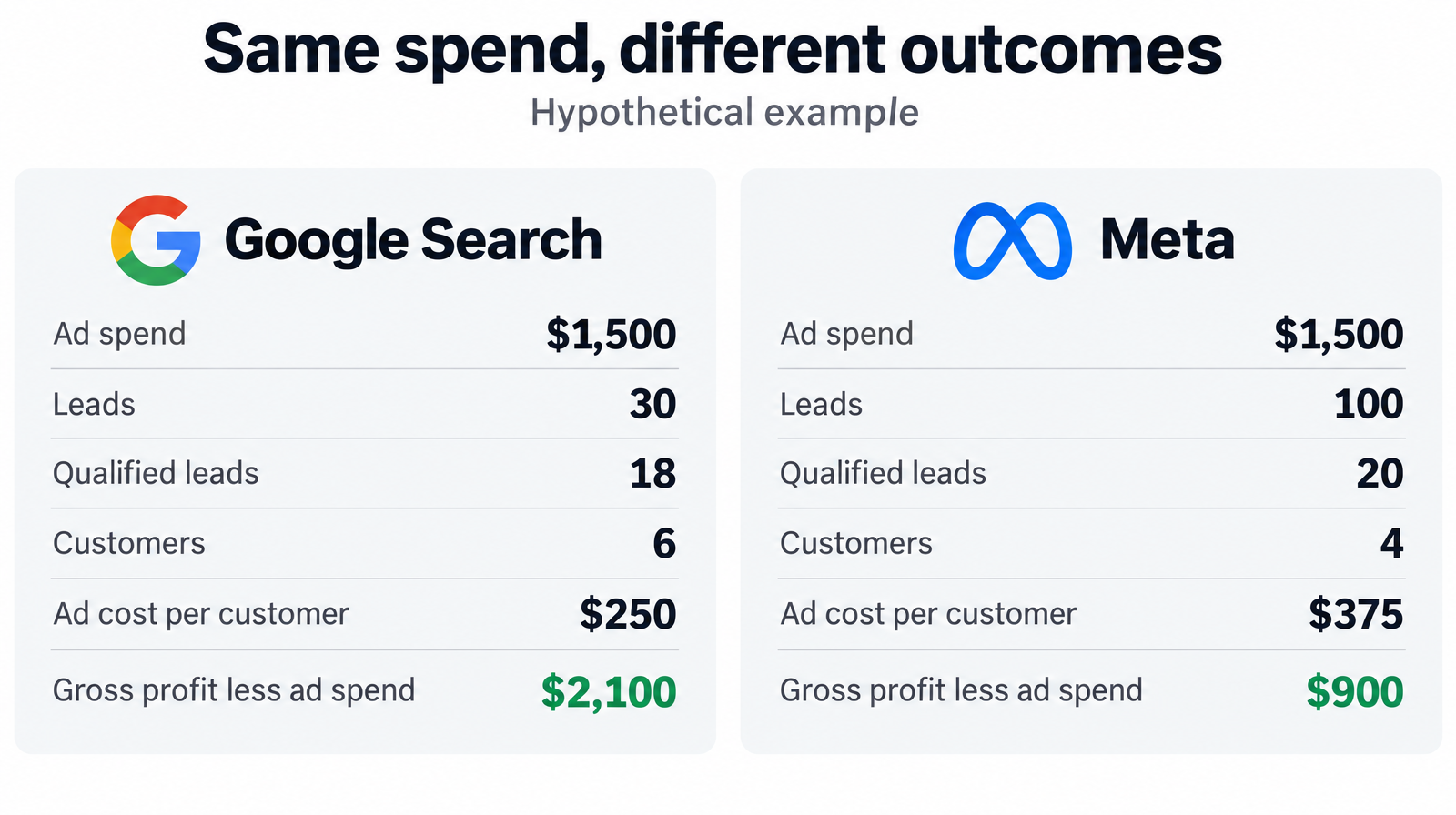
The answer depends on the entire sales funnel. Here is a hypothetical example using the same advertising spend for each platform.
| Monthly result | Google Search | Meta |
|---|---|---|
| Ad spend | $1,500 | $1,500 |
| Leads | 30 | 100 |
| Cost per lead | $50 | $15 |
| Qualified leads | 18 | 20 |
| Cost per qualified lead | $83.33 | $75 |
| New customers | 6 | 4 |
| Ad cost per customer | $250 | $375 |
| Gross profit before marketing, at $600 per customer | $3,600 | $2,400 |
| Gross profit less ad spend | $2,100 | $900 |
These are illustrative numbers, not client results or industry benchmarks. In this scenario, Meta produces cheaper leads and cheaper qualified leads, yet Google produces more profit because more prospects ultimately buy.
The reverse could easily happen if Meta's offer attracts better buyers or its follow-up system converts more appointments.
Use these formulas:
- Cost per qualified lead = advertising spend divided by qualified leads.
- Advertising cost per acquisition = advertising spend divided by new customers.
- Fully loaded customer acquisition cost = attributable marketing and acquisition expenses divided by new customers.
- Marketing ROI = (attributable gross profit before marketing minus marketing expenses) divided by marketing expenses.
A business earning $600 in gross profit per new customer cannot assume a $600 acquisition cost is sustainable. Overhead, service capacity and desired profit still matter. Set your acceptable acquisition cost accordingly.
A relevant offer and high-converting landing page design can improve the economics of either platform.
When to use both platforms together
Use both when each has a distinct role and the budget can support meaningful testing.
A local furniture store, for example, might introduce a promotion through Meta and capture later searches for the store or product through Google. A service company might use Google Search for immediate inquiries and Meta for educational content or eligible retargeting.
Be careful with attribution. Both platforms may claim credit for the same customer. Reconcile conversions with your CRM or transaction records rather than simply adding platform-reported revenue.
My Google and Meta Ads management services are designed around this broader customer journey.
How much should a local business allocate to each platform?
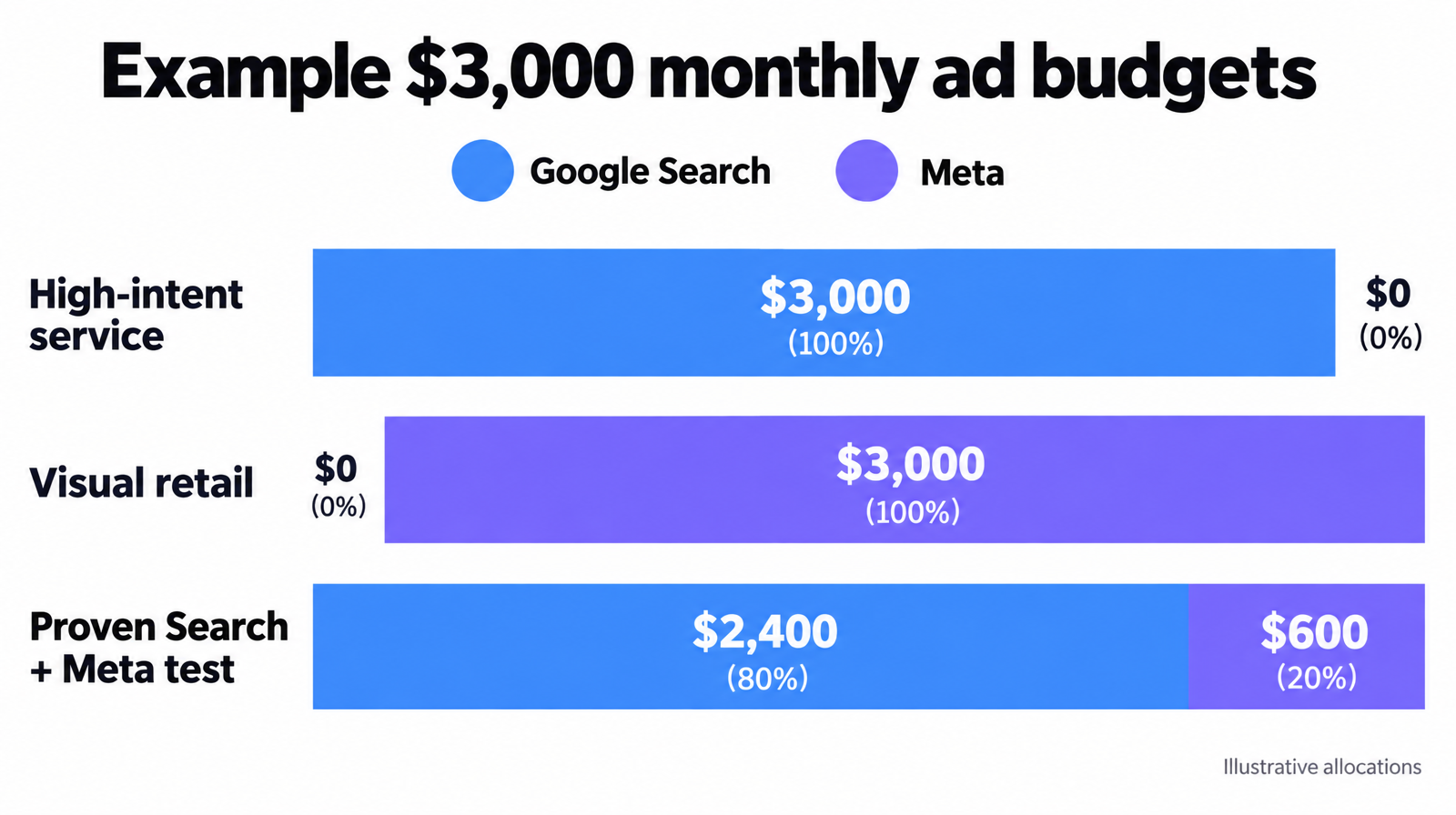
I do not recommend a fixed split for every business. The following are illustrative starting allocations for a business with $3,000 per month in media spend, excluding management and other costs.
| Situation | Google Search | Meta |
|---|---|---|
| Established high-intent service demand | $3,000 | $0 |
| Visual retail promotion or discovery-led offer | $0 | $3,000 |
| Proven Search campaign with room to test discovery | $2,400 | $600 |
The last allocation only makes sense if $600 is enough to test Meta in that particular market. Otherwise, keep the budget concentrated and test the second channel later.
For a Minneapolis contractor, the amount of relevant local search demand might determine how much Google can efficiently spend. For a Twin Cities retailer, creative production and promotion frequency might determine how effectively Meta can use the budget.
Increase spending where additional dollars are likely to acquire profitable customers. Do not assume yesterday's average acquisition cost will remain unchanged as spending increases.
Common mistakes local businesses make with paid ads
The mistakes I look for first are:
- Splitting a limited budget before either channel has enough data to evaluate.
- Sending visitors to a generic homepage that does not match the ad.
- Treating every form submission as a valuable lead.
- Expanding geography beyond the business's profitable service area.
- Changing offers, audiences and bidding strategies simultaneously, making results difficult to interpret.
- Ignoring unanswered calls, slow follow-up or unworked leads.
- Counting the same sale twice across advertising platforms.
If your Search campaign already receives traffic but fails to produce inquiries, my Google Ads troubleshooting guide can help isolate the problem before you spend more.
What does a winning local ad strategy actually look like?
Start with one offer, one clearly defined audience or search market, a conversion-focused destination and a measurable customer outcome.
- Set an allowable acquisition cost based on gross profit and business capacity.
- Choose the channel that best matches how your customers discover or search for the offer.
- Estimate the budget needed to test it under realistic click or lead costs.
- Build the landing page or lead form around that particular offer.
- Establish prompt, consent-based follow-up and record lead qualification in the CRM.
- Review qualified leads, appointments, sales and gross profit after enough time for the normal sales cycle.
- Fix the biggest bottleneck before scaling or adding another channel.
For local service businesses, my landing page checklist for Minneapolis businesses provides a practical starting point.
A campaign with strong click-through rates and weak sales may have a qualification or follow-up problem. A campaign with expensive clicks and strong close rates may actually be worth expanding. Diagnose the whole system rather than optimizing one metric in isolation.
How His Marketing Co helps Minneapolis businesses get more from their ad spend
I work directly with businesses to build advertising systems around meaningful outcomes, whether that means more qualified inquiries, appointments, store visits or sales. I am based in Minnesota and work with businesses nationwide.
My approach is to match the platform to customer behavior, build a conversion path that makes sense for the offer, and measure what happens after the lead comes in. You work directly with me rather than through an account manager.
If your business already has strong search demand, explore my Google Ads management for Minneapolis businesses. If you are unsure where your budget should go, book a strategy call and we can evaluate your market, offer, customer economics and current advertising before choosing a platform.